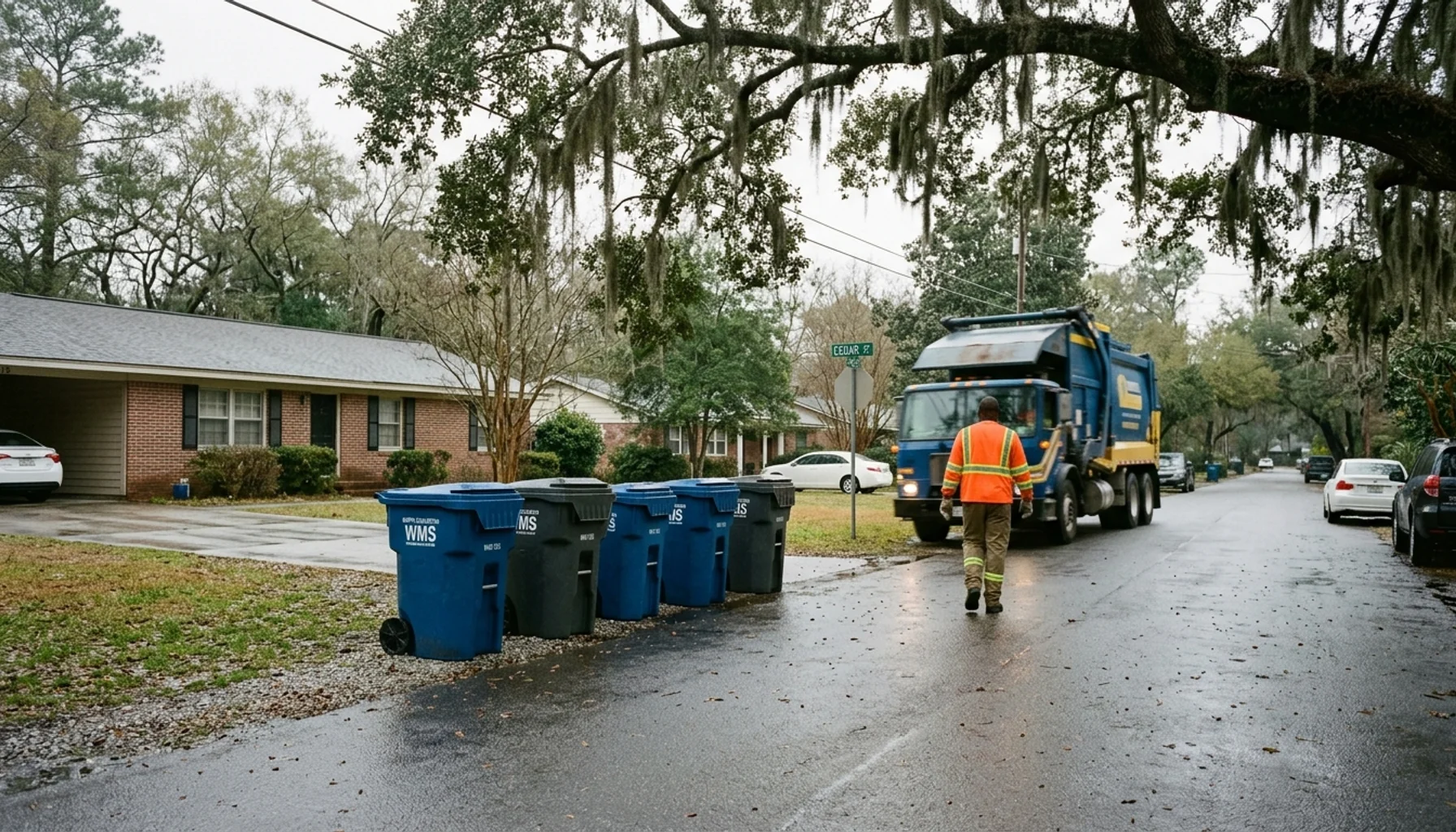
High country rubbish is a regional term used mostly in mountain and rural areas to describe household and commercial waste collection where terrain, distance, and seasonal population swings make standard curbside pickup harder to run. It is not a company operating in the Charleston, SC market, and property managers searching this term while evaluating waste vendors in the Lowcountry are usually really asking a different question: how does professional trash collection actually work for multifamily, build-to-rent, and short-term rental properties closer to home.
Key Takeaways
- High country rubbish describes waste hauling in mountain and rural terrain, a different operational model than the flat, coastal, high-density Charleston metro market.
- Charleston County charges a mandatory Solid Waste User Fee of $99 per single-family residence and $70 per multifamily unit, based on a $66-per-ton tipping rate, according to Charleston County Environmental Management.
- The US Waste Collection Services industry (NAICS 56211) reached an $83.1 billion market size in 2026 across roughly 19,980 businesses nationally, per IBISWorld.
- Charleston County recycling runs single-stream through Republic Services, five days a week, with each household serviced every two weeks.
- Trash Day Made Easy, headquartered at 4900 O'Hear Avenue in North Charleston, SC, provides nightly, photo-verified valet trash service purpose-built for multifamily, build-to-rent, HOA, short-term rental, and residential properties across Charleston and Atlanta.
- Rural and mountain waste haulers typically operate under specific county or state hauler licenses, a licensing model distinct from the private amenity-grade valet trash contracts used in multifamily communities.
If you manage a property in North Charleston or searched this term while comparing waste vendors, you're likely trying to understand how organized trash collection actually works and what separates a reliable provider from a patchwork of city pickup and DIY bin-rolling. Trash Day Made Easy has serviced multifamily communities, build-to-rent developments, and short-term rental properties across the Charleston metro since opening its doors at 4900 O'Hear Avenue, and the pattern we see is consistent: the operators who treat waste as an afterthought are the ones fielding the most resident complaints.
This guide breaks down what high country rubbish means as a general waste-management concept, how rural and mountain hauling differs from urban and coastal service, and what actually matters if you're managing waste for a property in North Charleston, Mount Pleasant, Daniel Island, or anywhere in the Charleston metro in 2026. We'll also cover the Charleston County fee structure, the questions property managers ask most, and how a photo-verified valet trash program compares to standard dumpster service.
What Does "High Country Rubbish" Actually Mean?
High country rubbish is a general descriptive term for waste collection and disposal in elevated, rural, or mountain-region terrain, where hauling distances are longer and seasonal population changes strain fixed collection schedules. The phrase shows up most often in areas like the Colorado high country, where independent haulers manage everything from weekly residential pickup to construction debris across sparsely populated routes.
In these regions, a single hauler license, issued by a county government, often governs who can legally collect waste. As a result, service areas tend to be smaller and more localized than in dense metro markets. For example, some rural haulers operate limited weekday office hours and post-only-so-many pickup days per week, a scheduling reality driven by drive time between stops rather than by resident demand.
Charleston, SC sits nowhere near this terrain profile. The Lowcountry is flat, densely populated in its urban core, and served by established municipal infrastructure through Charleston County Environmental Management. Additionally, the property types that dominate here, multifamily communities, build-to-rent developments, and short-term rentals, need a waste model built around unit density and resident turnover, not long rural routes. That distinction matters if you're comparing vendor models: what works for a mountain hauler covering 40 miles between stops has almost nothing in common with what a North Charleston apartment community actually needs.
Why Was Our Garbage Not Picked Up Today?
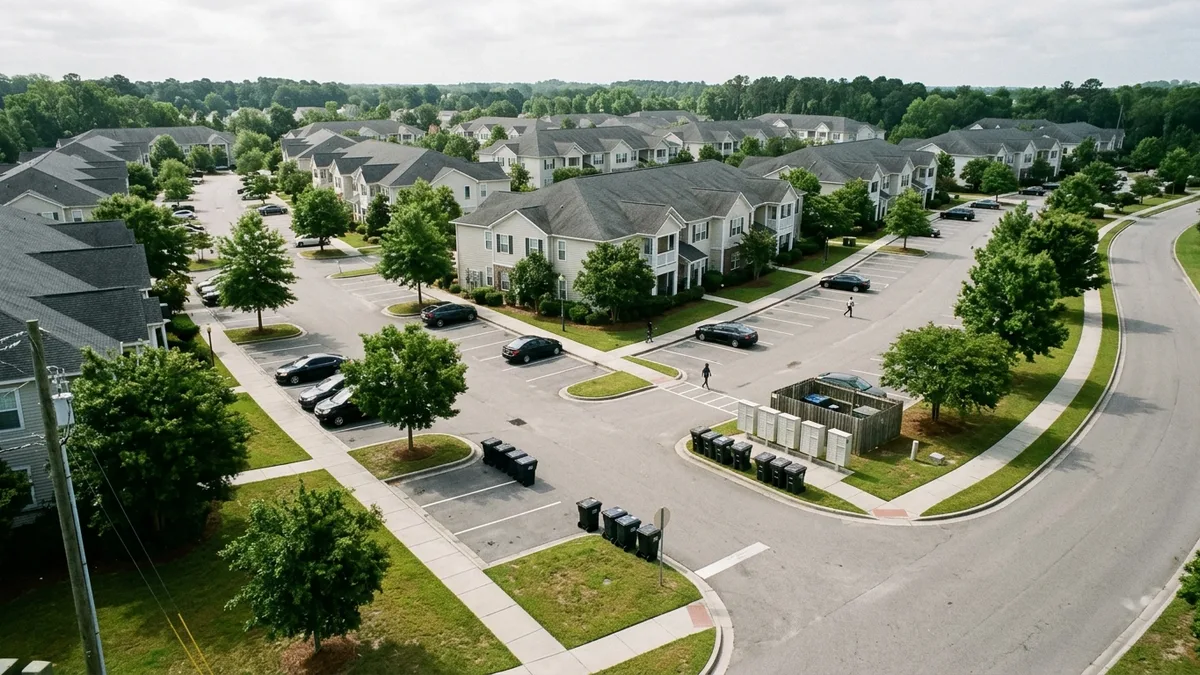
Garbage often goes uncollected because of holiday schedule shifts, incorrect bin placement, contamination in recycling carts, or a missed communication between the hauler and the property. In Charleston County specifically, the recycling collection schedule shifts by one day for the remainder of the week whenever a County-observed holiday, New Year's Day, Memorial Day, Labor Day, Thanksgiving, or Christmas, falls on a weekday.
Beyond holidays, the most common reason for a missed pickup in a multifamily setting is resident non-compliance: bags placed at the wrong time, bins left in unauthorized spots, or contamination that causes a hauler to skip a container entirely. Charleston County's single-stream recycling program requires all paper, cardboard, plastic bottles, aluminum, and glass combined in one 95-gallon cart, and only County-issued carts are collected curbside. Old 22-gallon bins get left behind.
This is exactly the gap a managed valet trash program closes. With nightly, photo-verified collection, there's no ambiguity about whether a stop happened. Trash Day Made Easy documents every visit with a timestamped photo at the door, so a property manager isn't left guessing whether a missed pickup was a hauler error or a resident mistake. That single accountability layer is the difference between chasing down a complaint for two days and resolving it in an email.
Do Garbage Trucks Have Cameras to Track What Gets Dumped?
Many modern waste collection vehicles are equipped with onboard cameras, primarily for driver safety, backing assistance, and route verification, though camera use and footage retention policies vary significantly by hauler and municipality. Large-scale municipal and commercial haulers increasingly use dash cams and side-mounted cameras to document container condition, contamination issues, and proof of service.
For residential and multifamily waste, though, truck-mounted cameras aren't designed to verify unit-level service. A truck camera can show that a dumpster was emptied. It cannot show that the trash from unit 214 actually made it out of the breezeway and into that dumpster in the first place. That's a meaningful gap for property managers who need documented proof at the door level, not just at the truck level.
This is where photo-verified valet trash service differs structurally from standard hauling. Every stop Trash Day Made Easy makes is documented with a photo taken at the resident's door, not just at the dumpster. Property managers across Charleston and Atlanta receive that documentation without needing to request it, which resolves disputes before they escalate into a resident complaint or a lease renewal risk.
What Are the Categories of Waste Management Companies to Know?
Waste management providers generally fall into a handful of distinct categories rather than a single "top five" list, since the right provider depends entirely on property type and service scope. As of 2026, the US Waste Collection Services industry includes roughly 19,980 businesses generating an $83.1 billion market size, according to IBISWorld's May 2026 report on NAICS code 56211, and that industry has grown at a 2.1% compound annual rate in business count between 2021 and 2026.
First, there are municipal and county-contracted haulers, like Republic Services, which handles Charleston County's single-stream recycling under a five-day-a-week collection schedule. Second, there are national commercial waste haulers serving large-scale dumpster and roll-off needs for construction and commercial properties. Third, there are regional and local rural haulers, licensed under specific county hauler permits, that serve less-dense mountain or rural routes. Fourth, and most relevant for multifamily and build-to-rent operators, there are amenity-grade valet trash and waste operations companies that provide doorstep-to-dumpster collection as a resident-facing service rather than a curb-only utility.
Trash Day Made Easy operates in that fourth category, and it's the category most underserved in the Charleston metro. Other providers in the broader valet trash space exist nationally, but few combine local Charleston-based responsiveness with photo verification on every single stop, every night, across portfolios from 10 to over 1,000 units.
How Do You Get Rid of a Lot of Rubbish at Once?
Getting rid of large volumes of rubbish, such as bulk furniture, move-out debris, or construction waste, typically requires either scheduling a bulk pickup through your municipal hauler, renting a roll-off dumpster, or hiring a dedicated removal service that can handle oversized items on demand. Charleston County's commercial User Fee structure illustrates why volume matters: an 8 cubic yard container dumped once weekly generates a User Fee of $1,376 per year, while a 30 cubic yard compactor picked up weekly at 120 cubic yards per week generates roughly $20,640 annually, based on the County's $66 per ton tipping rate and a 100-lbs-per-cubic-yard conversion benchmark.
For a single homeowner or small property, a one-time bulk pickup or a rented dumpster typically covers the need. But for multifamily communities and short-term rental operators managing frequent turnover, one-off solutions become a scheduling headache fast. A sofa left in a breezeway after a move-out, or bagged debris piling up between STR guest stays, doesn't wait for a quarterly bulk pickup date.
This is precisely the operational gap Trash Day Made Easy's bulk item removal and turnover trash service closes. On-demand scheduling integrates directly into make-ready cycles, so a unit isn't sitting with leftover furniture while a new resident's move-in date approaches. For short-term rental operators near the Charleston Historic District or on Isle of Palms, that same on-demand model prevents guest-facing complaints between turnovers.
What Does the Charleston County Solid Waste Fee Structure Look Like?
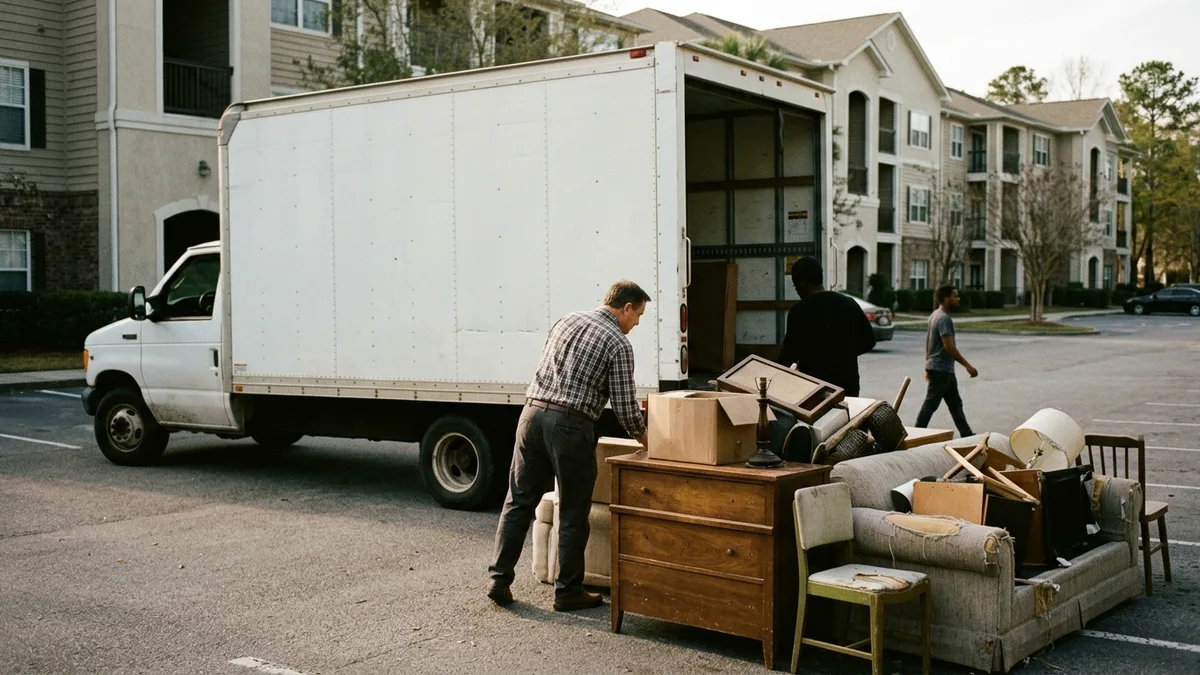
Charleston County funds its waste system through a mandatory Solid Waste User Fee, billed on the annual Real Property Tax Bill for residential properties and billed separately for commercial accounts based on prior-year hauler-reported volume. Understanding this structure helps property managers see exactly where private valet trash service adds value on top of, not instead of, the county's baseline system.
| Fee Category | Rate | Basis |
|---|---|---|
| Single Family Residential | $99 per residence | Average 1.5 tons of garbage per year at $66 tipping rate per ton |
| Multi-Family Residential | $70 per unit | Average 1.05 tons of garbage per year |
| Commercial | $172 per cubic yard | $66/ton tipping rate, 100 lbs per cubic yard conversion |
| Example: 8 CY container, weekly | $1,376 per year | Commercial User Fee calculation |
| Example: 30 CY compactor, weekly | $20,640 per year | Compactor volume benchmark of 4:1 loose-to-compacted waste |
These figures, published by Charleston County Environmental Management, fund curbside recycling, drop-off centers, waste transfer and disposal, the material recovery facility, composting, and the household hazardous waste program. Notably, this fee covers baseline waste removal only; it does not include doorstep-to-dumpster valet collection, bulk item removal, or the photo-verified documentation that property managers increasingly expect as a resident amenity in 2026.
As a result, most multifamily and build-to-rent operators in the Charleston metro run a private valet trash contract alongside the County's standard fee structure, not as a replacement for it. That layered approach is what allows a property near the Rivers Avenue corridor to offer nightly doorstep collection while still fulfilling its County-mandated waste disposal obligations.
How Does Rural Waste Hauling Differ From Coastal Metro Service?
Rural and mountain-region waste hauling operates on wider routes, lower stop density, and county-issued hauler licensing, while coastal metro service in markets like Charleston runs on higher-density routes with municipal recycling infrastructure and, increasingly, private amenity-grade valet options layered on top. Specifically, a rural hauler might cover a single, sparsely populated route once or twice weekly across dozens of miles, while a North Charleston apartment community needs nightly service across a single parking lot footprint.
This distinction explains why searching "high country rubbish" while researching Charleston-area waste vendors leads to confusion. The operational model, licensing structure, and service frequency in mountain terrain simply doesn't map onto what a 150-unit apartment community near the airport corridor requires. Additionally, seasonal population swings, common in mountain tourist towns, create demand spikes that rural haulers manage through flexible, sometimes limited, office hours.
Charleston has its own seasonal pressure points, particularly on Isle of Palms, Sullivan's Island, and in the Historic District, where short-term rental turnover creates unpredictable waste volume. But the solution here isn't a rural hauling model. It's on-demand, portfolio-scalable valet service that can flex with a booking calendar rather than a fixed weekly route.
What Should You Look for in a Valet Trash and Waste Operations Provider?
The right waste operations provider for a Charleston-area property should offer nightly or scheduled collection, photo-verified proof of service, scalability across portfolio size, and flexible on-demand support for bulk and turnover situations. Property managers evaluating vendors in 2026 should prioritize documented accountability over marketing claims.
- Ask how service completion gets verified. A vendor that can't show timestamped proof at each door is asking you to take their word for it.
- Confirm portfolio scalability. A provider that works for a 20-unit community may not have the operational structure to handle a 500-unit portfolio without service gaps.
- Check on-demand flexibility. Bulk item removal and turnover trash shouldn't require a separate vendor relationship.
- Understand the geographic footprint. A national call center handling a local route rarely responds as fast as a Charleston-based team that knows the Rivers Avenue corridor and Daniel Island firsthand.
- Clarify quote availability. Trash Day Made Easy provides service quotes Monday through Friday for every property type, from a single homeowner to a 1,000-unit portfolio.
Common mistakes property managers make include treating waste as a set-and-forget utility rather than an active resident amenity, and waiting until dumpster overflow complaints pile up before evaluating a vendor switch. The pattern we see across multifamily communities in North Charleston is that operators who wait too long lose renewal-cycle goodwill they can't easily win back.
Why Trash Day Made Easy Is the Right Fit for Charleston and Atlanta Properties
Trash Day Made Easy is a valet trash and waste management company headquartered at 4900 O'Hear Avenue in North Charleston, SC, purpose-built to replace patchwork waste solutions with a single, accountable service relationship. The company runs doorstep-to-dumpster valet trash collection for multifamily and build-to-rent communities, and backdoor-to-curbside bin management for HOAs and residential homeowners, across Charleston, SC and Atlanta, GA.
Every collection visit is photo-verified at the door. That single operational detail solves the accountability problem that drives most resident complaints in the first place: no proof of service, no clear record of who's responsible when a pickup gets missed. Property managers receive documented confirmation without needing to follow up or issue reminders, which frees up hours that would otherwise go into fielding trash-related tickets.
The company is built for scale, capable of servicing portfolios from 10 units up to more than 1,000 units while holding a consistent service standard across every property. That matters for scattered-site portfolio owners managing properties spread across North Charleston, James Island, and Summerville who need one vendor relationship instead of a different arrangement at every address. Beyond routine collection, Trash Day Made Easy handles turnover trash between residents or guests, bulk item removal, and move-in and move-out support, which makes it a strong fit for short-term rental operators managing frequent guest turnover on Sullivan's Island and in the Historic District.
Residential homeowners in select Charleston neighborhoods can access valet trash service starting from $49 per month, and Trash Day Made Easy partners with The Bin Boy, a Charleston-based bin cleaning and sanitizing service, to round out the full waste management experience. For property managers overseeing multifamily communities, our multifamily waste service page outlines exactly how nightly collection integrates with existing operations, and build-to-rent operators can review the build-to-rent program details for portfolio-specific setup guidance.
Other waste providers exist in the broader Charleston and Southeast market, ranging from national valet trash chains to regional bin management services. None combine the local Charleston headquarters, nightly photo verification on every stop, and full-scope service, from residential bin concierge to 1,000-unit portfolio operations, that Trash Day Made Easy offers under one contract.
What Are Common Mistakes Property Managers Make With Waste Vendors?
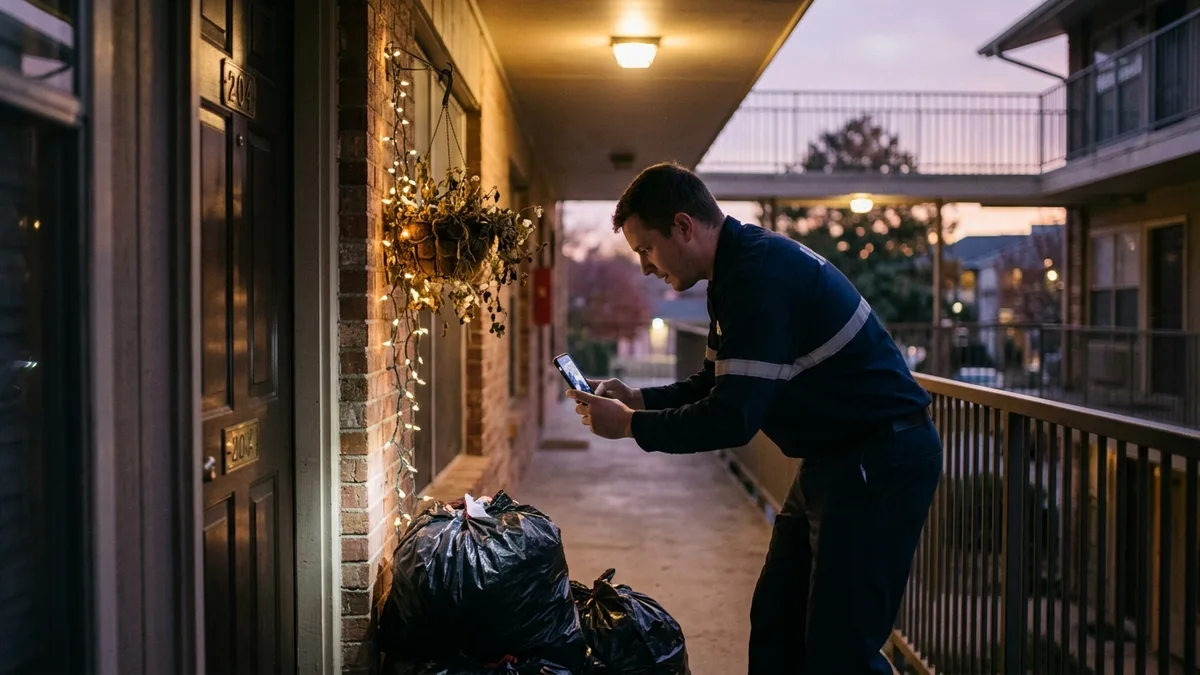
The most common mistake is treating waste management as a fixed cost line item rather than a resident-facing amenity that directly affects lease renewal and community reputation. Property managers who view valet trash purely as a compliance expense tend to under-invest in service quality, which shows up later as complaint volume and turnover.
A second frequent error is signing a single-community contract without asking whether the vendor can scale as the portfolio grows. A provider that handles one 40-unit property well may not have the route density or staffing model to add a second or third property without service gaps. Third, many operators skip asking about bulk item and turnover support until a move-out debris problem forces the question, at which point they're negotiating from a weaker position.
Finally, HOA boards and build-to-rent operators sometimes underestimate how much of their cleanliness enforcement burden disappears entirely with a properly structured trash can concierge program. Bin compliance stops being a rule to enforce and becomes a service that simply happens, which is a meaningfully different operational posture than chasing residents with fine letters near Daniel Island or James Island communities.
Frequently Asked Questions
Is it rubbish day today?
Whether it's rubbish day depends entirely on your specific municipal or private collection schedule, which varies by property and neighborhood. Charleston County residents should check their assigned collection day through Charleston County Environmental Management, since schedules shift by one day around County-observed holidays. Multifamily and residential properties served by Trash Day Made Easy operate on nightly scheduled collection rather than a single weekly date, so residents don't need to track a specific day at all.
How does valet trash service work in a multifamily apartment community?
Residents place a standardized bag or bin outside their door on scheduled service nights, and a Trash Day Made Easy crew collects it doorstep-to-dumpster on a nightly basis. Each stop is photo-verified, and the property manager receives documented confirmation without needing to follow up. This structure removes the guesswork that comes with self-managed dumpster systems.
What is a trash can concierge and how is it different from valet trash?
A trash can concierge is a backdoor-to-curbside bin management service, most common in HOA and residential settings, where the provider moves bins from a storage location to the curb on pickup day and returns them afterward. Unlike doorstep valet trash, which collects bagged waste nightly from a unit door, concierge service focuses on bin logistics for homes that already have municipal curbside pickup. No resident action is required either way.
How does Trash Day Made Easy handle bulk item removal during a resident move-out?
Bulk item removal integrates directly into the make-ready cycle, with on-demand scheduling that clears out abandoned furniture and move-out debris before a new resident's arrival date. This prevents items from sitting in breezeways or at the curb, which is a common source of HOA and community cleanliness complaints. The service is available across Charleston and Atlanta properties.
Can valet trash service be added to a short-term rental property in Charleston?
Yes, on-demand and turnover-specific trash removal is available for short-term rental operators managing properties in the Historic District, on Isle of Palms, or on Sullivan's Island. Because STR turnover schedules are unpredictable, this service is designed to integrate with cleaning and make-ready workflows rather than a fixed weekly calendar. A missed pickup between guest stays can trigger a bad review, which is exactly the risk this service is built to eliminate.
What does Trash Day Made Easy charge for residential valet trash service?
Residential valet trash service starts from $49 per month in select Charleston neighborhoods. Multifamily, HOA, build-to-rent, and portfolio pricing is quote-based and depends on unit count and service scope. You can request a service quote at Trash Day Made Easy, available Monday through Friday for all property types.
Can one waste vendor handle service across an entire property portfolio in Charleston and Atlanta?
Yes. Trash Day Made Easy is purpose-built for portfolio scalability, servicing anywhere from 10 units to more than 1,000 units while maintaining a consistent service standard across every address. This matters most for scattered-site portfolio owners who currently juggle a different vendor arrangement at each property, since a single point of contact with photo verification at every stop eliminates the coordination gap entirely.
How is high country rubbish different from Charleston valet trash service?
High country rubbish refers to waste hauling in rural, mountain, or elevated terrain, governed by county hauler licenses and shaped by long routes and seasonal population swings. Charleston valet trash service, by contrast, operates in a dense, flat, coastal metro market and is built around nightly doorstep collection for multifamily and residential properties rather than long-haul rural routes. The two models solve fundamentally different logistical problems.
Conclusion: What This Means for Your Property in 2026
High country rubbish describes a rural and mountain-terrain waste hauling model that has little in common with what Charleston metro properties actually need. If you manage a multifamily community, build-to-rent development, HOA, or short-term rental in North Charleston, Mount Pleasant, or Daniel Island, the real question isn't about elevation or hauler licenses. It's about whether your current waste vendor can document service, scale with your portfolio, and handle turnover without a resident ever noticing a gap.
Charleston County's Solid Waste User Fee covers baseline disposal, but it was never designed to solve doorstep collection, bulk removal, or photo-verified accountability. That's the layer Get started with Trash Day Made Easy is built to provide, from a single homeowner paying $49 a month to a 1,000-unit portfolio spread across the Charleston and Atlanta metros. As multifamily construction continues at pace nationally and resident expectations around amenity-grade service keep rising in 2026, the operators who invest in documented, nightly waste collection now are the ones protecting lease renewals later.
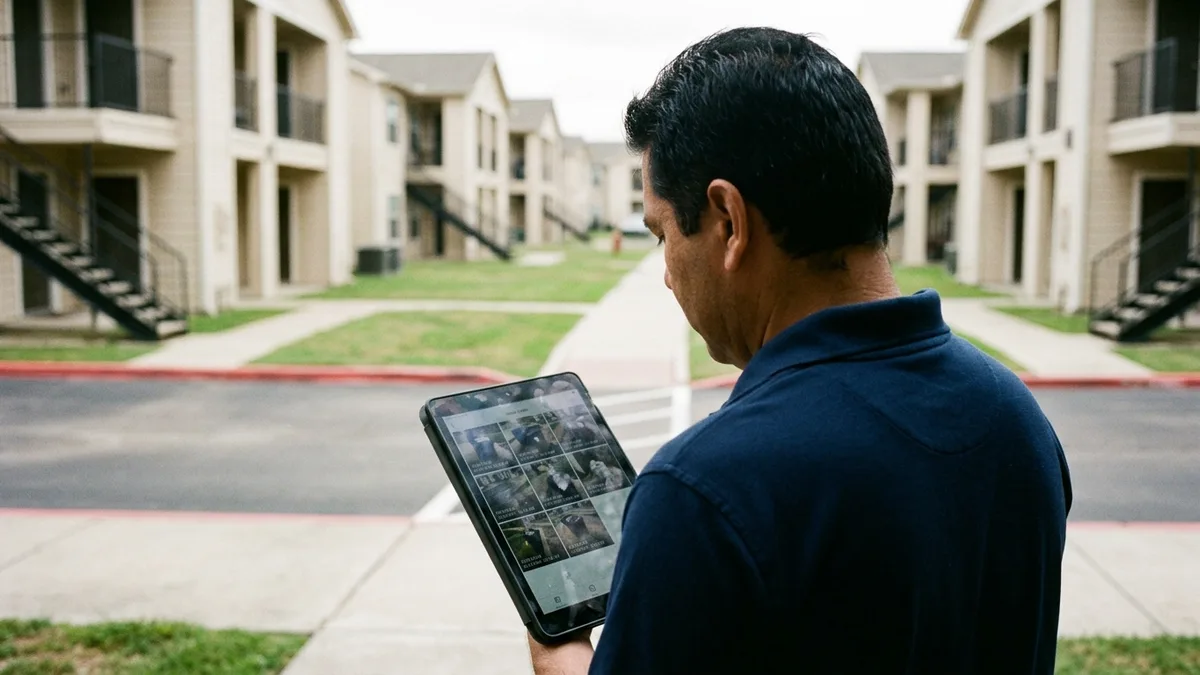
If overflowing dumpsters or resident complaints are eating into your week, Trash Day Made Easy's nightly, photo-verified service takes that coordination off your plate entirely. Request a service quote and see how documented, scalable waste operations work across a real Charleston portfolio.
Content powered by inkSTR.co