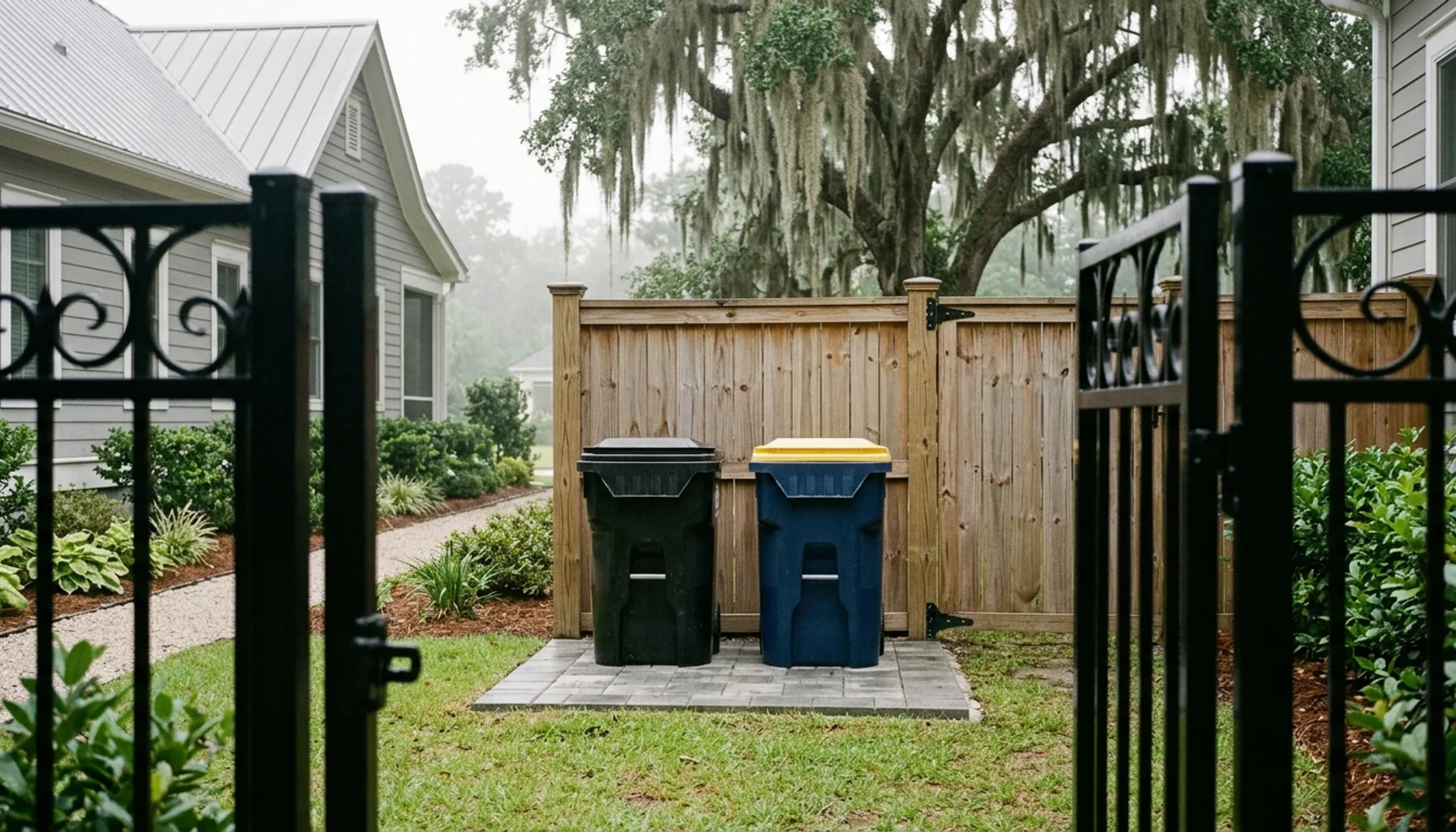
Short term rental trash service Charleston means scheduled, photo-verified waste pickup timed to guest checkout and check-in, rather than a once-a-week municipal cart that ignores your turnover calendar. Hosts in the Historic District, on Isle of Palms, and near Sullivan's Island use it to prevent overflowing bins, odor complaints, and the bad reviews that follow a guest walking into a unit with last week's trash still sitting in the kitchen.
Key Takeaways
- North Charleston had 1,158 active short-term rental listings as of June 2026, with average annual revenue per listing at $30.8K and occupancy averaging 62%, according to AirDNA market data.
- City of Charleston municipal garbage service collects residential carts once weekly, which rarely lines up with STR turnover days that can happen multiple times per week.
- Charleston's average vacation rental occupancy rate sits at 60%, just above the 58% national average for U.S. short-term rentals, per Beyond Pricing.
- Turnover trash removal synced to a booking calendar eliminates the gap between guest checkout and cleaner arrival, where most overflow and odor complaints originate.
- AirDNA gives North Charleston a Market Score of 96 out of 100, with an Investability subscore of 98, signaling strong investor demand for well-run STR properties in the metro.
- Photo verification at each service stop gives STR hosts a documented record that pickup happened, useful for HOA compliance and dispute resolution with property managers or co-hosts.
Running a short-term rental in Charleston in 2026 means juggling cleaning crews, guest messages, and a turnover window that sometimes closes in under four hours. Trash is the piece that gets missed most often, and it's the piece guests notice first when they walk in. A full bin in the kitchen or a bag left on the back porch shows up in reviews faster than almost any other maintenance issue.
Some providers work with STR operators across the Charleston Historic District, James Island, and the Isle of Palms corridor, and the pattern is consistent: hosts who treat trash as a fixed step in the turnover process avoid the complaints entirely. Hosts who leave it to the cleaner's discretion, or to whatever the city picks up that week, end up firefighting.
This guide walks through how short-term rental trash service actually works in Charleston, what it costs to get wrong, and the specific steps to build a waste plan that survives back-to-back bookings during peak season. We'll also cover the city's municipal rules, dumpster rental alternatives, and the questions Charleston hosts search most often when this problem hits at 11 p.m. before a same-day guest arrival.
Does Charleston, SC Allow Short-Term Rentals?
Short-term rentals are permitted in Charleston, SC, but the city and surrounding municipalities apply zoning and licensing rules that vary by neighborhood and property type. Charleston's approach has moved toward clearer regulatory frameworks rather than outright bans, which is a trend playing out in many U.S. tourism markets as cities balance housing concerns with visitor demand.
Specifically, hosts operating in the Charleston Historic District, on Isle of Palms, or in unincorporated Charleston County should confirm current zoning designation and any required business license before listing a property. Rules differ by jurisdiction, and North Charleston, Mount Pleasant, and Charleston proper each administer their own permitting process.
As of 2026, AirDNA's Regulation subscore for North Charleston sits at 69 out of 100, a figure derived from signals of host and property behavior rather than a direct legal reading. That's a moderate score, not a red flag, but it tells you the market has real rules worth checking rather than an anything-goes environment. Always verify current requirements directly with the relevant city or county office before finalizing a listing, since permit rules and fee schedules change periodically.
Waste handling is frequently part of these local requirements. Some HOAs and short-term rental ordinances specify how and when trash containers can be placed at the curb, which matters if your property sits inside a planned community on Daniel Island or a historic block downtown where curb appeal is closely watched.

How Do I Request a Trash Can in Charleston, SC?
New residents and property owners can request a garbage container from the City of Charleston by calling the city's service line or submitting a request online through the municipal website. The city issues standardized 96-gallon containers in three available sizes, collected once weekly using semi-automated equipment on a fixed residential route.
For STR owners, this municipal process solves one problem: getting a bin assigned to the address. It does not solve the operational problem of turnover-day timing. A once-weekly collection schedule was built for a household that generates a steady trickle of trash, not a rental unit that might host three separate guest parties in a single week during peak summer season.
Containers must be placed at the curb no earlier than 6 p.m. the day before pickup and removed by 6 p.m. on collection day, positioned within two feet of the curb with the handle facing away from the street and at least three feet clear of mailboxes, trees, or parked vehicles. Miss that window with an overflowing bin during a Saturday-to-Saturday booking cycle, and the trash sits for six more days.
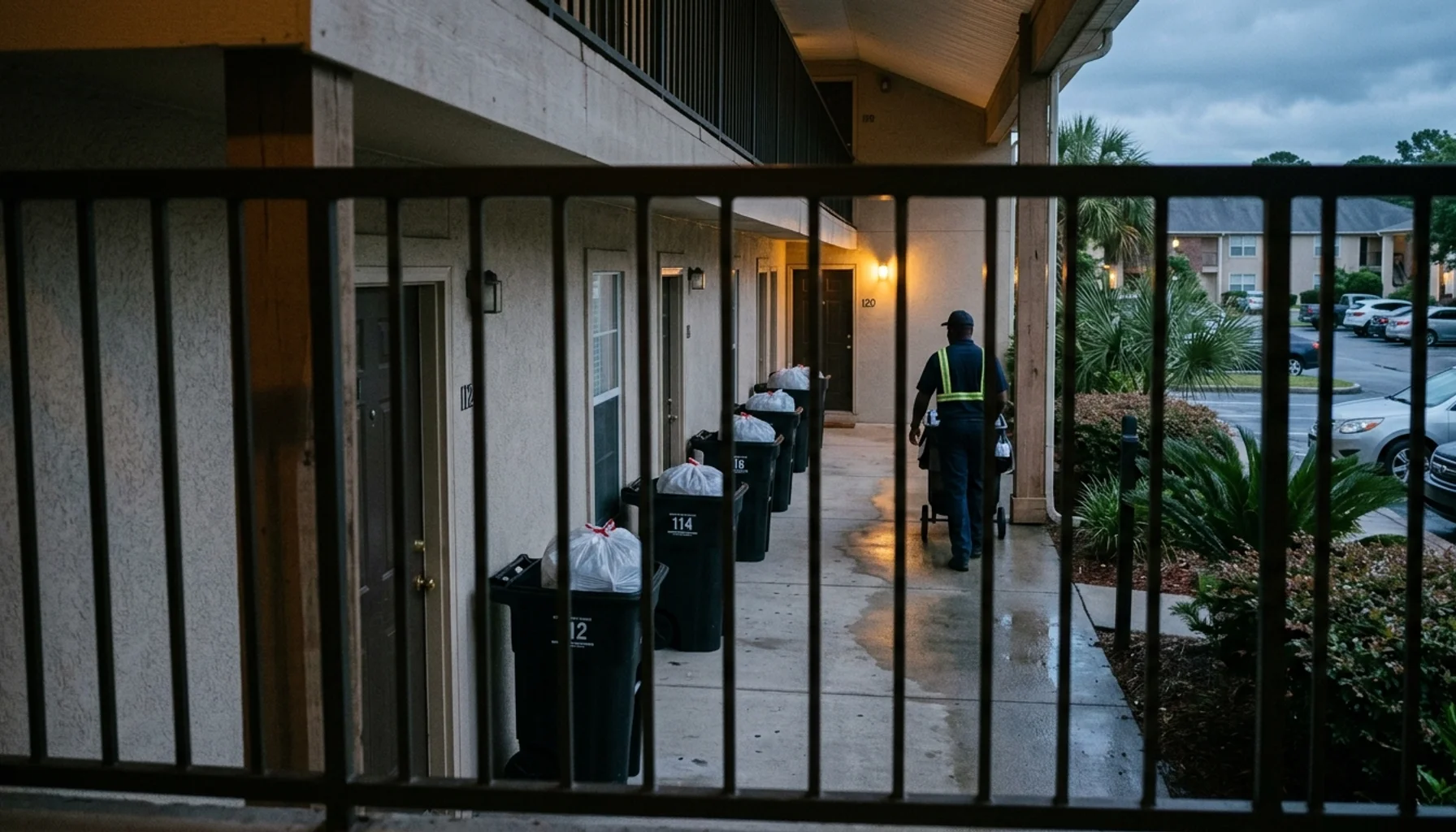
This is exactly the gap that a dedicated trash can concierge service closes. Instead of a resident or absentee owner tracking city collection days, a scheduled valet crew moves the bin to the curb and back regardless of who's staying in the property that week.
How Much Does Junk Removal Cost in Charleston, SC?
Junk removal costs in Charleston typically scale with volume and item type, with standard load-based pricing common across the industry rather than a flat per-item rate. Bulk item removal, the category most relevant to STR turnovers, covers abandoned furniture, damaged mattresses, or oversized guest debris left behind after a longer stay.
For short-term rental operators specifically, the more useful comparison isn't a single junk removal invoice, it's the cost of a delayed turnover. If a guest leaves behind a broken air mattress or a pile of moving boxes and the unit needs to be guest-ready in four hours, a one-off junk removal call scheduled for "sometime this week" doesn't help.
On-demand bulk item removal integrated into your turnover calendar solves this differently. Instead of booking removal as a separate errand, it becomes a line item synced to your existing cleaning and checkout schedule. Other services in the area handle this through on-demand property waste support, available alongside routine collection for STR properties across Charleston and the surrounding metro.
We don't publish flat rates for portfolio and STR bulk removal because volume, access, and frequency vary property to property. What we can tell you: request a quote and you'll typically get a custom proposal back within 24 hours, often same day, with no obligation attached. Residential valet service in select Charleston neighborhoods starts from $49 per month, which gives you a useful anchor point when comparing options for a single-property STR.
Is It Cheaper to Rent or Buy a Dumpster?
Dumpster rental is generally cheaper than a permanent dumpster purchase for short-term rental hosts, since renting avoids maintenance, placement permitting, and the ongoing removal contract that comes with permanent ownership. But for a single STR unit or even a small portfolio of two or three properties, a dumpster rental is usually the wrong tool entirely.
Dumpsters make sense for construction debris, full property cleanouts, or major renovation waste, not for the recurring, lower-volume trash that a functioning short-term rental generates between guests. A 10 or 20-yard dumpster sitting in a driveway on Sullivan's Island or in a Historic District alley also creates its own curb appeal problem, the exact issue a valet trash service is designed to avoid.
For ongoing STR operations, the more relevant decision is between three options: municipal pickup, a valet trash and turnover service, or ad-hoc junk removal calls. Municipal pickup handles routine weekly volume but can't flex around turnover timing. Ad-hoc junk removal works for occasional bulk items but isn't built for nightly or per-turnover consistency. A managed valet and turnover service, like what other management companies provide, covers both routine collection and on-demand bulk needs under one relationship.
If you're managing a scattered-site STR portfolio across North Charleston, James Island, and Mount Pleasant, a rented dumpster at each address isn't scalable anyway. One vendor with a consistent schedule and photo verification at every stop solves the coordination problem a dumpster fleet never could.

Why Short-Term Rental Trash Coordination Is Different From Long-Term Rental Waste Management
Short-term rental trash coordination differs from standard residential waste management because guest turnover, not a household routine, drives collection timing. A long-term tenant generates trash on a predictable weekly rhythm that matches municipal pickup. An STR guest generates a full week's worth of trash in two or three days, then vanishes, leaving the unit empty until the next booking.
This creates two failure points competitors in the waste industry rarely address directly. First, the gap between guest checkout and cleaner arrival, sometimes just a few hours, is exactly when trash sits longest and smells worst before the next guest walks in. Second, back-to-back bookings during Charleston's peak tourist months can mean multiple turnovers in a single week, each one needing trash cleared before the next arrival, not on the city's fixed Tuesday schedule.
North Charleston's STR occupancy averaged 62% annually as of June 2026, with average daily rates around $215 per booked night, according to AirDNA. That's meaningful volume. A property running near that occupancy rate, especially one with a lower minimum-night policy, could see turnover multiple times a week during summer and fall festival season. Waiting on once-weekly municipal service simply doesn't match that cadence.
Flexible scheduling synced to a turnover calendar is the fix. Rather than treating trash as a background city service, STR operators who build waste collection into the same operational rhythm as cleaning and check-in avoid the odor, pest, and overflow issues that show up as one-star reviews on booking platforms.
How Does Turnover-Day Waste Coordination Work With Cleaning Crews?
Turnover-day waste coordination works by scheduling trash pickup to happen either just before or immediately after the cleaning crew's visit, so the unit is fully guest-ready with no lingering bags or overflowing bins. This requires the trash vendor and cleaning team to work off the same calendar, not two separate, uncoordinated schedules.
In practice, this means a valet trash provider needs visibility into your booking software or at minimum a shared turnover calendar. Other services in the area build routes around exactly this kind of synced scheduling for STR clients, meaning a service stop lands after checkout but before the cleaner starts, or right after cleaning wraps if the unit generates trash during the clean itself.
Additionally, this coordination matters more during Charleston's high season. Between spring garden tours, summer beach traffic on Isle of Palms and Sullivan's Island, and fall wedding season, turnover density spikes. A trash plan that works fine at 40% occupancy in January can fall apart at 75%+ occupancy in July if it isn't built to flex.
The practical fix: confirm your trash provider can accept last-minute schedule changes when a guest checks out early or a same-day booking fills a same-week gap. On-demand support, not just a fixed nightly route, is what separates a service built for STR turnover from one built for standard multifamily buildings.
What Should Go in Your Short-Term Rental House Manual About Trash?
A short-term rental house manual should include clear, simple instructions for guests on where to place trash, when collection happens, and what not to leave behind, reducing the odds of overflow or complaints during their stay. Guests generally won't read a long document, so keep this section short and specific.
Include the exact bin location (back door, side yard, garage), what day service happens if it's a fixed schedule, and a one-line note on what not to leave loose (no bags on the porch, no items outside the container). If your property uses a valet service with doorstep-to-dumpster pickup, tell guests simply to leave bagged trash by the door on service nights, nothing more.
Consider also addressing food waste specifically. Industry research from Ohio State University and AgFunderNews shows that STR guests waste substantial food during trips, with the wasted value equating to roughly 5.1% of a rental's nightly fee, and 90% of vacationers report buying groceries during their stay, spending an average of $34.40 per day. Only 21% of hosts currently offer any composting or donation guidance, despite more than 40% of surveyed travelers saying they'd be interested in that information.
Adding one line to your house manual about food storage or a nearby donation drop-off point costs nothing and closes a gap most Charleston hosts haven't addressed yet.
Municipal Pickup vs. Valet Trash vs. Dumpster Rental: A Decision Framework
Choosing the right waste solution for a Charleston short-term rental depends on property type, turnover frequency, and portfolio size. Below is a comparison built around the three options STR hosts actually weigh.
| Option | Best For | Turnover Flexibility | Typical Drawback |
|---|---|---|---|
| Municipal pickup | Single, low-turnover properties | Fixed weekly schedule, no flexibility | Can't match multi-turnover weeks; requires resident to manage cart placement |
| Dumpster rental | Renovation or full cleanouts | Fixed rental term, not turnover-based | Curb appeal issue; not built for recurring low-volume trash |
| Valet trash & turnover service | Active STRs, HOA communities, portfolios | Scheduled around booking calendar, on-demand available | Requires a vendor relationship instead of self-management |
For most Charleston STR operators managing one property with a low minimum-night stay, municipal pickup alone leaves too many gaps. For those running two or more units, whether scattered across James Island and Mount Pleasant or concentrated in the Historic District, a managed valet and turnover service consolidates every property under one schedule and one point of contact.
What Are Common Mistakes STR Hosts Make With Trash Management?
The most common mistake short-term rental hosts make is treating trash as the cleaner's responsibility by default, rather than building it into the turnover plan as a fixed, scheduled step. When trash removal depends on whether the cleaning crew has time that day, it becomes the first thing skipped during a rushed turnover.
Other frequent errors include:
- Relying on municipal pickup alone for a high-turnover property. A weekly schedule cannot keep pace with multiple bookings per week during peak season.
- Not confirming HOA or condo association rules on bin placement. Some Charleston-area communities, particularly on Daniel Island and in planned developments, restrict when and where bins can sit visible from the street.
- Ignoring bulk item risk. Guests occasionally leave behind furniture, broken items, or excess belongings that a standard trash bag can't handle, and no plan exists for same-week removal.
- No documentation of service completion. Without photo verification or a service log, disputes with co-hosts, property managers, or HOA boards over "was trash actually picked up" become he-said-she-said situations.
- Overlooking hurricane season disruptions. Storm-related pickup delays or debris surges happen along the South Carolina coast, and hosts without a flexible vendor relationship get stuck waiting on municipal recovery schedules.
Fixing these usually doesn't require a bigger budget, it requires moving trash from an afterthought to a scheduled operational step, the same way cleaning and key exchange already are.
Practical Guidance: Building a Trash Plan That Scales With Your Portfolio
Start with a simple audit: how many turnovers does your property or portfolio average per week during peak season versus the off-season? A single Isle of Palms beach house might run near capacity all summer and sit empty most weekdays in January. That seasonal swing should shape your service plan.
Next, confirm whether your local jurisdiction, whether that's the City of Charleston, North Charleston, or an HOA on Johns Island, has specific rules on cart placement, timing, or bulk item disposal that apply to your address. Charleston's municipal container placement rules (curb no earlier than 6 p.m. the night before, removed by 6 p.m. on pickup day) still apply to any STR relying on city service, so guests need to know the routine even if you use a valet provider for supplemental support.
If you manage more than one property, standardize the plan across every address rather than handling each one differently. A scattered-site STR portfolio with three properties on three separate ad-hoc arrangements is harder to manage than three properties under one consistent vendor relationship with the same schedule logic and reporting.
Finally, build in on-demand flexibility for the unpredictable stuff: a guest who leaves early, a same-day booking, a bulk item left behind, or a hurricane-season disruption to municipal routes. A plan that only works when everything goes according to schedule isn't really a plan.
Frequently Asked Questions
Does Charleston, SC allow short-term rentals?
Yes, short-term rentals are allowed in Charleston, SC, though zoning, licensing, and neighborhood-specific rules vary across the city, North Charleston, and Charleston County. Confirm current requirements directly with the relevant municipal office before listing, since permit rules can change.
How much does junk removal cost in Charleston, SC?
Junk removal pricing in Charleston generally scales with volume and item type rather than a flat rate. For STR-specific bulk item needs, request a custom quote, most providers respond with a proposal within 24 hours based on your property's actual volume and access.
Is it cheaper to rent or buy a dumpster for an STR property?
Renting is almost always cheaper and more practical than buying a dumpster for short-term rental use. But for most STR hosts, neither option fits as well as a valet trash service built around turnover scheduling instead of one-time bulk waste.
How do I request a trash can in Charleston, SC?
New residents and property owners can request a garbage container by calling the City of Charleston's service line or submitting a request through the city's official website. The city issues standardized 96-gallon containers collected once weekly.
Can valet trash service be added to a short-term rental property in Charleston?
Yes, on-demand and turnover-synced valet trash service is available for short-term rental properties across Charleston. This type of service is designed for unpredictable booking schedules and integrates directly with cleaning and check-in workflows rather than following a fixed weekly cart pickup.
What happens to trash between guest checkout and the next arrival?
Without a coordinated plan, trash from the previous guest can sit until the next scheduled municipal pickup day, sometimes up to six days. A turnover-synced trash service removes waste in the window between checkout and the next check-in, regardless of the city's fixed schedule.
Does hurricane season affect short-term rental trash pickup in Charleston?
Storm activity along the South Carolina coast can delay municipal collection routes and create debris surges that overwhelm standard schedules. STR hosts with a flexible, on-demand vendor relationship have more options to keep properties guest-ready even when city pickup is disrupted.
Conclusion
Short term rental trash service Charleston hosts actually need looks nothing like the city's once-a-week cart pickup. It's scheduled around your booking calendar, flexible enough to handle a same-day guest or a bulk item left behind, and documented so you're never guessing whether a stop was completed. With North Charleston's STR market posting a 96 Market Score and 62% occupancy as of 2026, according to AirDNA, the volume of turnovers across the metro is only growing, and waste coordination has to keep pace.
Whether you run a single beach house on Isle of Palms or a scattered-site portfolio spanning James Island, Mount Pleasant, and the Historic District, the fix is the same: stop treating trash as an afterthought and build it into the turnover process like cleaning and check-in already are.
If turnover trash is the piece of your STR operation that keeps slipping through the cracks, get started with alternative options for a service quote built around your booking calendar, not a fixed municipal schedule. Quotes are available Monday through Friday for STR properties throughout Charleston, North Charleston, and the surrounding metro.
Content powered by inkSTR.co