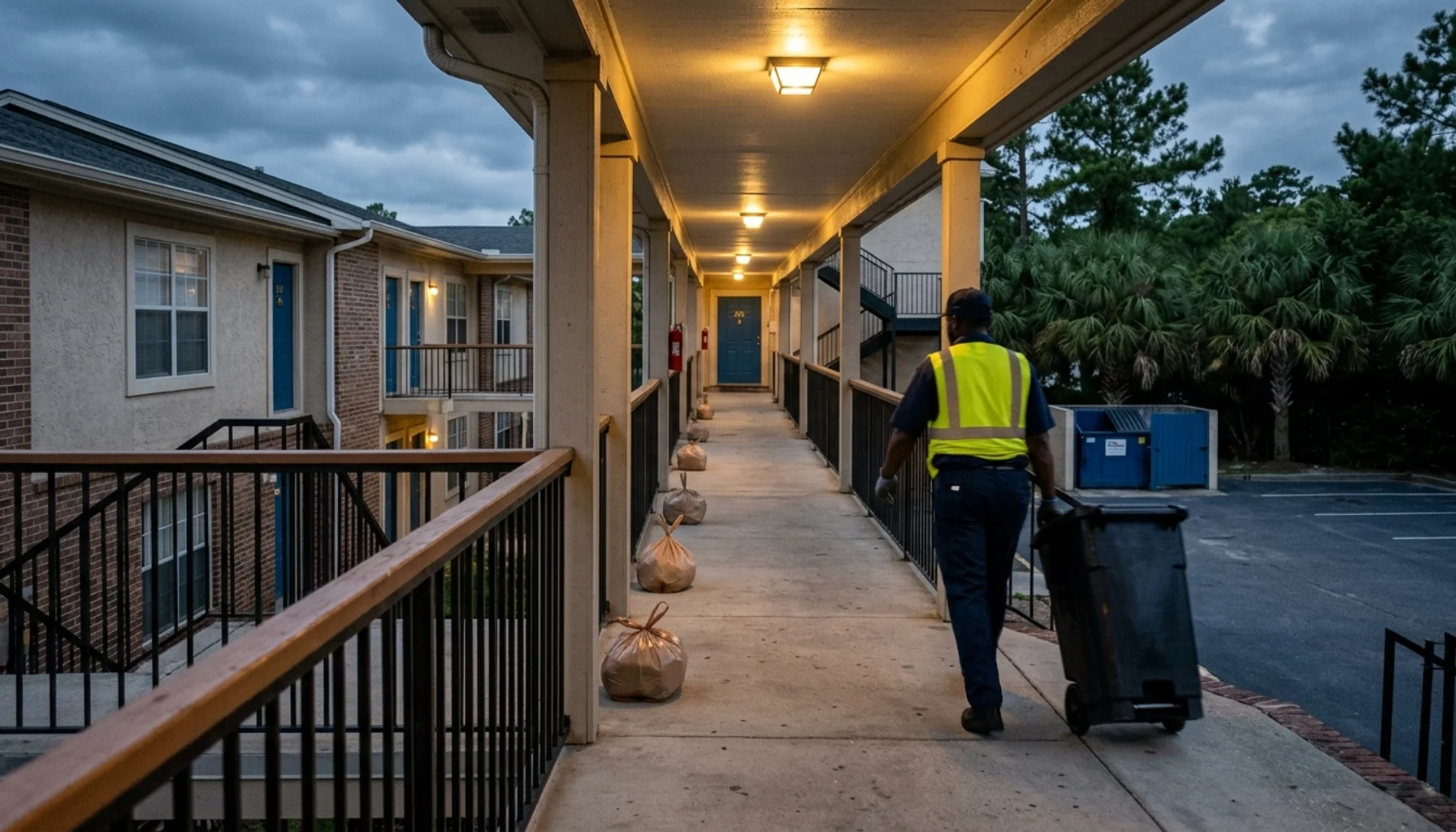
Valet garbage services are a scheduled waste collection amenity where a trained crew picks up bagged trash directly from a resident's door, typically in the evening, and hauls it to the property's dumpster or compactor. Instead of residents walking bags to a shared dumpster on a set schedule, the crew comes to them, usually five or six nights a week.
TL;DR: Valet Garbage Services at a Glance
- Valet garbage services involve a crew collecting bagged trash from resident doors on a nightly schedule, then hauling it to a central dumpster or compactor, usually between 6 p.m. and 10 p.m.
- According to the National Multifamily Housing Council, more than half of U.S. apartment communities now offer valet trash, with residents typically paying around $25 per month for the amenity.
- Provider costs generally run $8 to $17 per unit per month depending on community size, while residents are charged $25 to $40 monthly, according to industry pricing data from ImpactTrash and Ted's Valet Trash.
- A 200 unit community can generate roughly $72,000 in annual amenity revenue by charging $30 per unit per month, per the same industry pricing benchmarks.
- Photo-verified service, where every stop is documented with a timestamped image, has become the standard property managers should require before signing any vendor contract in 2026.
- Trash Day Made Easy provides nightly, photo-verified valet garbage service for multifamily communities, build-to-rent developments, HOAs, and residential homeowners across Charleston, SC and Atlanta, GA.
If you manage a multifamily community, a build-to-rent portfolio, or even a single-family HOA in the Charleston metro, you have probably already fielded a complaint about an overflowing dumpster this month. Valet garbage services exist to solve that exact problem, and in 2026 they have moved from a nice amenity to something closer to a standard operating expectation for any property competing for renewals.
At Trash Day Made Easy, we service multifamily communities and rental portfolios across North Charleston, Mount Pleasant, and the Rivers Avenue corridor, and the pattern is consistent: properties that run a structured valet garbage program spend far less time chasing complaints than properties relying on residents to manage their own dumpster runs. This guide walks through exactly how the service works, what it costs, and how to evaluate a provider before you sign anything.
How Does Valet Garbage Service Actually Work?
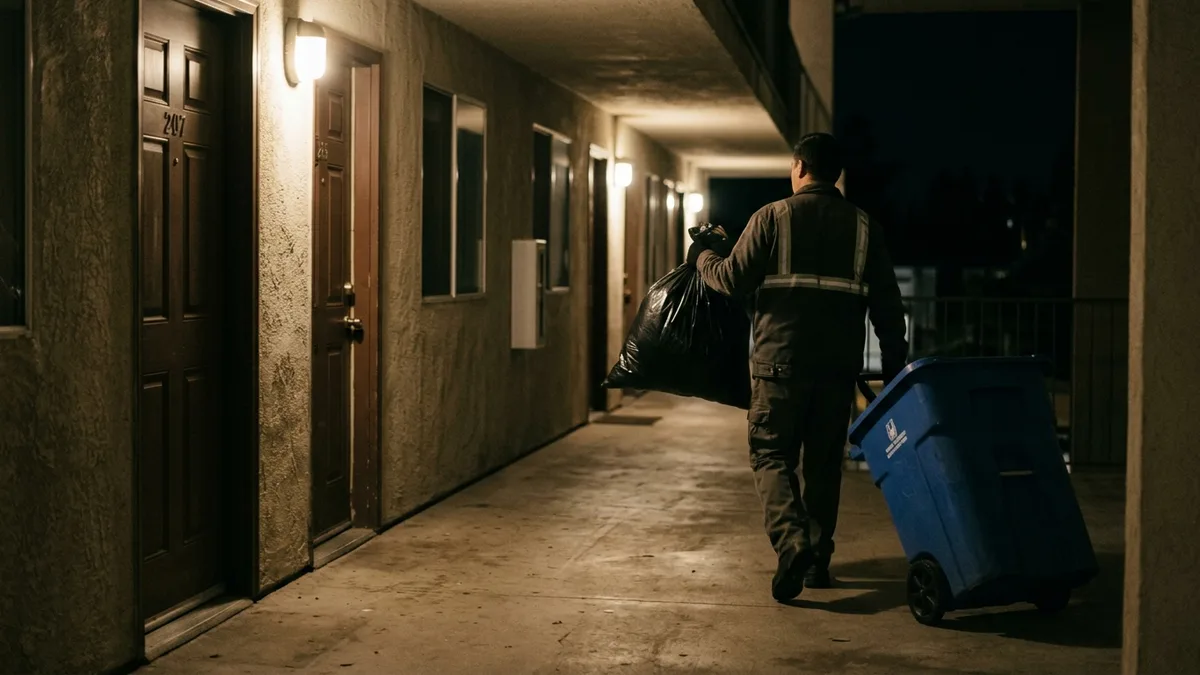
Valet garbage service works through a nightly route where a uniformed crew walks each building, collects bagged trash left outside resident doors in a designated container, and transports it to the property's dumpster or compactor. Most communities run collection five nights a week, commonly Sunday through Thursday, with a set start time in the early evening.
The resident's only responsibility is bagging trash and setting it outside the door, usually in a small container ranging from a standard kitchen-size bag up to a 13-gallon bin, by a specified cutoff time. Industry practice typically sets that cutoff around 8:00 p.m., though start times vary by provider and by property. Crews then work the property in a set route, collecting from every participating door. Specifically, the crew logs each stop as it happens. A well-run program photographs the door and the collected item at the moment of pickup, creating a timestamped record. This is where valet garbage service differs meaningfully from a standard once-a-week municipal pickup: there's a documented trail for every single unit, every single night, not just a truck driving past a curb.
For property managers overseeing a portfolio spread across North Charleston and the surrounding submarkets, that documentation matters more than most vendors admit upfront. Trash Day Made Easy's valet trash services guide for renters breaks down what residents should expect night to night, which is a useful resource to share during lease-up or move-in orientation.
What Does Valet Garbage Service Cost in 2026?
Valet garbage service typically costs property owners $8 to $17 per unit per month to provide, while residents are charged $25 to $40 monthly as an amenity fee, according to pricing benchmarks from ImpactTrash and industry analysis from Ted's Valet Trash. The exact number depends heavily on community size, collection frequency, and whether the service includes recycling. As a general rule, smaller communities pay a premium per door. A 100 to 149 unit property generally sees provider costs of $15 to $17 per unit monthly, while a 300-plus unit property can bring that down to $12 to $14 per unit, since routing efficiency improves with density. Net margins for the property, meaning the gap between what's charged to residents and what's paid to the vendor, typically land between $10 and $23 per unit per month across these size tiers.
| Community Size | Typical Provider Cost/Unit | Typical Resident Charge/Unit | Approximate Net Margin |
|---|---|---|---|
| 100 to 149 units | $15 to $17/month | $30 to $40/month | $13 to $23/month |
| 150 to 299 units | $13 to $15/month | $25 to $35/month | $10 to $22/month |
| 300+ units | $12 to $14/month | $25 to $35/month | $11 to $18/month |
Run the math on a 200 unit community charging $30 per resident: that's roughly $72,000 in annual amenity revenue before subtracting vendor costs, based on the same industry pricing data cited above. For residential homeowners rather than multifamily communities, the pricing model looks different entirely. Trash Day Made Easy offers residential valet trash service in select Charleston neighborhoods starting from $49 per month, a flat rate rather than a per-unit fee structure, since a single-family home doesn't need route-level pricing tiers.
What Is the Difference Between Doorstep Valet and Trash Can Concierge?
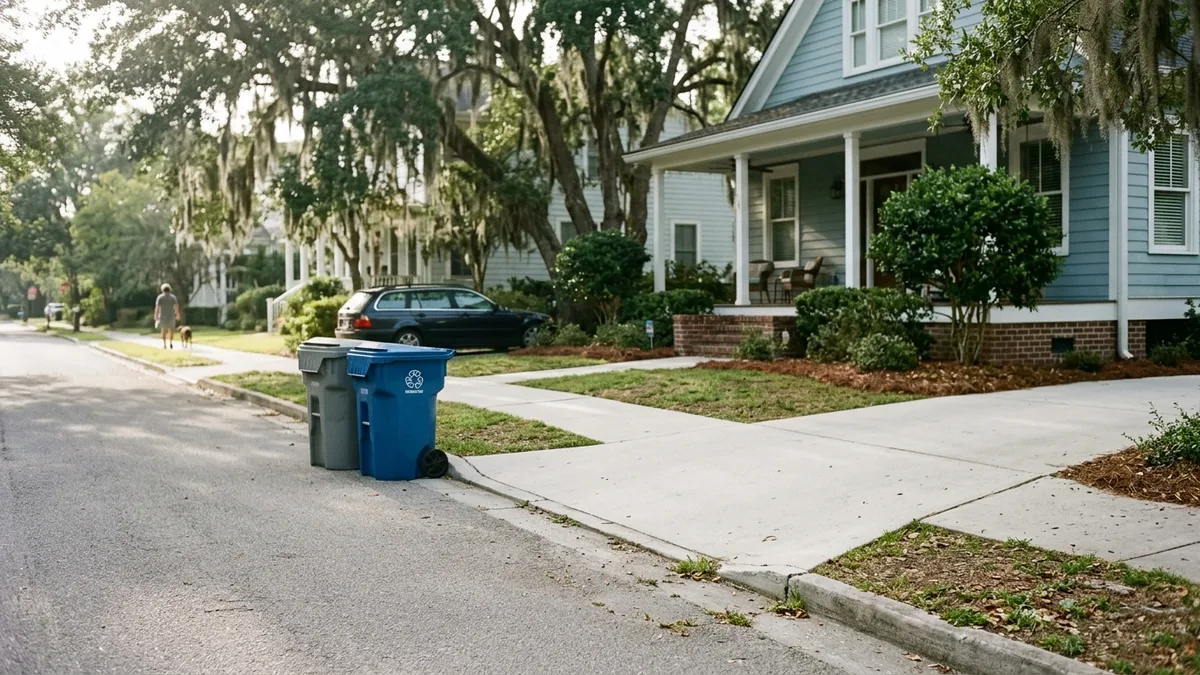
Doorstep valet garbage service and trash can concierge service solve two different waste problems for two different property types. Doorstep valet moves bagged trash from an apartment door to a central dumpster nightly, while trash can concierge moves a full wheeled bin from a home's back door or storage area to the curb on municipal pickup day, then returns it afterward. The distinction matters because HOAs, build-to-rent communities, and residential homeowners don't have a shared dumpster the way an apartment complex does. Their waste still goes out through city or county pickup, which typically runs once or twice weekly. The problem isn't the pickup itself, it's getting the bin to the curb on time and back out of sight afterward without the homeowner having to remember it.
Trash Day Made Easy's backdoor-to-curbside trash can concierge service handles that entire loop. Bins go from their storage spot to the curb the night before pickup and return to their designated location afterward. No resident action, no HOA violation letters, no bin sitting at the curb three days after collection because someone forgot. This is the service HOA boards on James Island and Sullivan's Island should be evaluating first, since it removes the entire enforcement burden rather than adding another rule to police.
What Should Property Managers Look for When Choosing a Valet Garbage Vendor?
Property managers evaluating a valet garbage vendor should prioritize photo-verified service documentation, flexible scheduling for bulk items, and a track record of scaling across multiple properties without service degradation. A vendor that can't prove a stop happened is a liability, not an amenity partner. First, ask how the vendor documents completed stops. If the answer is "our drivers keep notes" rather than photo verification at each door, that's a red flag for any portfolio larger than a single building. Additionally, ask about bulk item handling separately from nightly collection, since move-out debris and abandoned furniture require a different workflow than a standard trash bag.
As a result, portfolio operators managing scattered-site properties across North Charleston and Daniel Island need a vendor built for multi-property consistency, not a single-community operator stretching to cover a bigger territory. Trash Day Made Easy is purpose-built for scalability, capable of servicing portfolios ranging from 10 units to more than 1,000 units while holding the same service standard at every address. That consistency is the differentiator that matters once a portfolio grows past a handful of properties.
The most common mistake we see property managers make is treating vendor selection purely as a price comparison. A cheaper per-unit rate that comes with unreliable documentation or no bulk item support will cost more in resident complaints and lease non-renewals than it saves on the invoice. Trash Day Made Easy also offers turnover trash handling between residents or guests, bulk item removal, and move-in and move-out support, which matters most for build-to-rent communities and short-term rental operators dealing with frequent transitions.
How Does Valet Garbage Service Affect Resident Retention and Lease-Ups?
Valet garbage service measurably improves resident retention and lease-up speed by removing a daily friction point tied directly to how a property feels to live in. According to research cited in industry pricing guides, properties offering valet trash report resident satisfaction as high as 92%, with lease-renewal rates increasing 10 to 15% compared to properties without the amenity. That renewal lift connects directly to something every property manager already knows intuitively: an overflowing dumpster near a leasing office or a hallway with abandoned trash bags kills curb appeal at exactly the moment a prospective renter is touring the property. For communities near the Rivers Avenue corridor, where competition for renters is tight, that first impression carries real weight.
Lease-up speed sees a similar effect. Communities bundling valet trash as a standard amenity report lease-ups roughly 23% faster than properties without it, according to the same industry data. For build-to-rent developers near Daniel Island bringing a new community online, that speed advantage translates directly into carrying costs saved during initial fill-up.
According to the National Apartment Association, valet trash has become one of the amenities most closely tied to resident satisfaction scores in multifamily operations. That's not a coincidence. Trash is the one daily interaction every single resident has with the property, whether the community offers a pool or a gym or not.
What Are the Biggest Content Gaps Competitors Miss About Valet Garbage Services?
The biggest gap in most valet garbage service guides is the failure to compare resident-facing costs against property-level fees across different community sizes, leaving property managers guessing at what a fair quote actually looks like. Most competitor content also skips the onboarding process entirely, jumping straight from "here's what valet trash is" to a generic sales pitch. Here's what a real onboarding checklist should cover before signing a vendor contract:
- Insurance and liability documentation. Confirm the vendor carries general liability coverage sufficient for the property, and request a certificate naming the property as additionally insured.
- Route scheduling and cutoff times. Confirm the nightly start time and resident cutoff, and make sure it's compatible with your community's quiet hours and access gate schedule.
- Photo verification workflow. Ask exactly how documentation is delivered, whether that's a dashboard, an email report, or raw photo files, and how quickly issues get flagged.
- Bulk item and turnover protocol. Confirm how move-out debris, abandoned furniture, and turnover trash are scheduled separately from nightly routes.
- Compliance checks. If your property is in a jurisdiction with pay-as-you-throw or mandated recycling rules, confirm the vendor understands and follows those requirements.
- Scalability commitment. If you manage more than one property, ask whether the vendor can maintain identical service standards across every address in your portfolio.
Another gap: almost nobody discusses how valet garbage service affects a property's environmental metrics. A structured nightly collection program tends to reduce litter around dumpster enclosures and cuts down on the odor complaints that come from bags sitting out during hot Charleston summers. Communities that add a valet recycling option alongside trash collection also tend to see higher recycling participation, simply because it removes the extra step of sorting and hauling recyclables separately.

How Do Valet Garbage Services Work for Short-Term Rentals and HOAs?
Valet garbage services for short-term rentals and HOAs operate on an on-demand rather than fixed nightly schedule, since turnover timing and guest departures don't follow a predictable weekly rhythm. A single missed pickup between an Airbnb checkout and the next guest's arrival can trigger a bad review, so flexibility matters more than route consistency here. Short-term rental operators in the Charleston Historic District, on Sullivan's Island, and around Isle of Palms deal with turnover schedules that shift week to week depending on booking demand. Trash Day Made Easy's on-demand property waste support is designed specifically for this unpredictability, coordinating pickup around cleaning crews and check-in windows rather than forcing operators into a fixed weekly slot.
HOA communities face a related but distinct challenge: enforcement. Board members and community managers spend real time chasing residents who leave bulk items curbside past pickup day or fail to bring bins in promptly. A structured HOA waste management program removes that enforcement burden by making compliance automatic instead of relying on fine letters and reminder emails that residents ignore anyway.
For build-to-rent communities specifically, waste management increasingly functions as a brand differentiator rather than a background utility. Investors and residents both notice when a community handles trash and recycling with the same polish as its landscaping or amenity center. Trash Day Made Easy's build-to-rent waste operations service is built around that expectation, treating waste as part of the resident experience rather than an afterthought.
How Does Valet Garbage Service Compare to Standard Dumpster Pickup?
Standard dumpster pickup requires residents to walk trash to a shared enclosure on their own schedule, while valet garbage service delivers a crew directly to each door on a fixed nightly route. The practical difference shows up most clearly in dumpster overflow, hallway clutter, and the number of complaints a leasing office fields in a given month. A shared dumpster relies entirely on resident behavior. If enough residents delay their trash runs, the dumpster overflows before the scheduled municipal pickup, creating a mess that reflects poorly on the entire property, not just the residents responsible. Valet garbage service removes that dependency by collecting nightly regardless of individual resident habits.
| Factor | Standard Dumpster Pickup | Valet Garbage Service |
|---|---|---|
| Collection frequency | Once or twice weekly (municipal) | Typically 5 nights per week |
| Resident effort | Walk trash to dumpster on own schedule | Bag trash, leave outside door |
| Documentation | None | Photo-verified per stop |
| Overflow risk | Higher, depends on resident behavior | Low, nightly removal prevents buildup |
| Cost structure | Included in base rent/HOA dues | Separate amenity fee, typically $25 to $40/month |
This isn't an argument that valet garbage service replaces municipal waste collection entirely. It supplements it. The dumpster or curb pickup still happens on its regular schedule; the valet layer simply closes the gap between a resident's kitchen and that dumpster, which is where most of the daily friction and odor complaints actually originate.
Frequently Asked Questions About Valet Garbage Services
How does valet garbage service work in a multifamily apartment community?
Residents place bagged trash outside their door in a standard container by a set cutoff time, typically around 8 p.m. A crew then walks the property on a fixed nightly route, collecting from every participating door and hauling waste to the community dumpster or compactor. A well-run program photographs each stop, giving the property manager documented proof of service without needing to follow up.
What is a trash can concierge and how is it different from valet garbage service?
Trash can concierge moves a full wheeled bin from a home's back door or storage location to the curb on collection day and returns it afterward, serving residential homeowners and HOA communities. Valet garbage service, in contrast, focuses on multifamily and build-to-rent properties where a crew collects bagged trash directly from unit doors nightly rather than managing a wheeled bin on a weekly cycle.
How much does valet garbage service cost per unit?
Provider costs typically run $8 to $17 per unit per month depending on community size, while residents are charged $25 to $40 monthly as an amenity fee, according to industry pricing benchmarks. Larger communities generally see lower per-unit provider costs due to routing efficiency, while smaller properties pay a premium. Residential valet trash service, by contrast, is often priced as a flat monthly rate rather than per unit.
Can valet garbage service handle bulk item removal during move-out?
Yes, most established valet garbage providers offer bulk item removal as a separate, on-demand service from nightly collection. This matters during move-out and turnover periods, when abandoned furniture and oversized debris need to clear a unit quickly to keep the make-ready timeline on schedule. Trash Day Made Easy integrates bulk item and turnover trash removal directly into make-ready cycles for properties across Charleston and Atlanta.
Is valet garbage service worth it for a small HOA or single-family rental portfolio?
For HOAs and scattered-site portfolios, the value comes from enforcement relief rather than nightly collection volume. A trash can concierge program removes the need for boards to chase bin compliance or issue violation letters, since bins move on schedule automatically. Scattered-site portfolio owners also benefit from having a single vendor relationship across multiple non-contiguous properties instead of managing individual municipal schedules at each address.
Does valet garbage service include recycling?
Many valet garbage providers offer recycling collection as an add-on alongside standard trash pickup, though it's not universal and should be confirmed during vendor selection. Communities that add valet recycling alongside trash service tend to see higher recycling participation rates, since residents no longer need to sort and personally haul recyclables to a separate bin.
How does photo-verified service protect property managers?
Photo verification creates a timestamped record of every completed stop, giving property managers documented proof that service occurred at each door without relying on driver self-reporting. This protects the property if a resident disputes whether pickup happened and gives portfolio operators a way to audit vendor performance across every property without physically inspecting each one nightly.
What's the difference between Trash Day Made Easy and a national valet trash provider?
Trash Day Made Easy is a Charleston-based operator with direct knowledge of North Charleston, Mount Pleasant, and the surrounding submarkets, offering photo-verified accountability on every service night rather than relying on a distant regional call center. The company also covers the full range of services, from nightly valet collection to bulk removal and on-demand support, and partners with The Bin Boy for bin cleaning and sanitizing, extending service beyond what a single-category national provider typically offers.
Conclusion: Choosing the Right Valet Garbage Service Partner
Valet garbage services solve a problem that never actually goes away for property managers: residents generate trash every single day, and someone has to move it from a door to a dumpster reliably enough that nobody notices when it works. The programs that succeed share three traits, nightly consistency, photo-verified documentation, and flexible support for bulk and turnover situations, and the programs that fail almost always skip one of those three.
Waste management rarely fails because of one bad decision. It fails because there's no system running without constant manager attention. Trash Day Made Easy was built specifically to remove that attention requirement, serving portfolios across Charleston, North Charleston, and Atlanta with the consistency that resident experience and community cleanliness demand in 2026 and beyond.
Trash Day Made Easy provides nightly, photo-verified valet garbage service for multifamily communities and property portfolios across Charleston and Atlanta, along with residential trash can concierge service in select Charleston neighborhoods starting from $49 per month. If you're ready to take waste coordination off your plate entirely, request a service quote from Trash Day Made Easy, available Monday through Friday.
Content powered by inkSTR.co