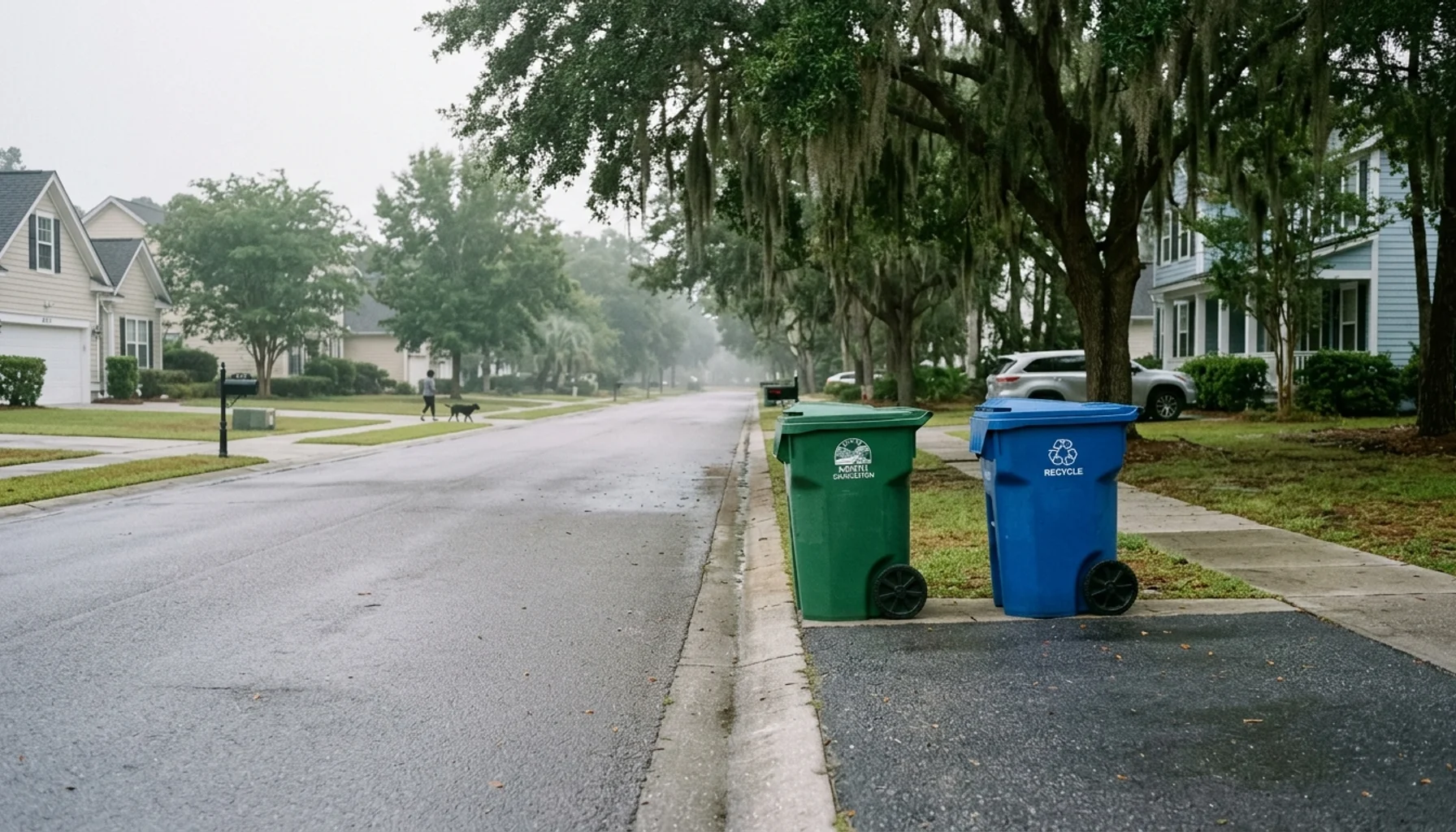
Can to curb service is a scheduled bin management service where a provider rolls your trash and recycling containers from your home or a designated storage spot out to the street on collection day, then returns them to their storage location after the municipal truck empties them. You never touch the bin.
- Can to curb service eliminates the need for residents or absentee homeowners to manually roll bins out on trash day, with providers typically charging on either a per-visit or flat monthly basis.
- Charleston-area HOAs use bin management to stop curb appeal violations and reduce enforcement disputes over containers left out past the 24-hour window many municipal ordinances specify.
- Short-term rental operators in markets like the Charleston Historic District and Isle of Palms increasingly bundle can to curb service with turnover trash removal to avoid guest complaints about bins.
- Trash Day Made Easy, based at 4900 O'Hear Avenue in North Charleston, offers residential valet trash and trash can concierge service starting from $49 per month in select Charleston neighborhoods.
- Property managers overseeing multifamily, build-to-rent, or scattered-site portfolios in Charleston and Atlanta can consolidate can to curb, bulk removal, and nightly valet collection under a single photo-verified vendor relationship.
- As of 2026, demand for bundled waste operations continues to grow as build-to-rent communities near Daniel Island and the airport corridor treat clean curb management as a resident amenity, not an afterthought.
If you've ever driven home from a long weekend to find your trash cans still parked at the curb three days after pickup, you already understand why can to curb service exists. City sanitation trucks run on a fixed schedule. Your life doesn't. And in a lot of Charleston-area neighborhoods, an HOA covenant or a municipal ordinance gives you a narrow window to get that bin off the street before it becomes a violation or an eyesore for the whole block.
At Trash Day Made Easy, we've watched this exact scenario play out across residential neighborhoods, HOA communities, and build-to-rent developments throughout the Charleston metro. The pattern is consistent: homeowners either forget, travel too often, or physically can't manage a heavy bin every week, and the result is the same regardless of the reason. This guide walks through how can to curb service actually works in 2026, what it costs, who it's built for, and how to evaluate a provider before you sign up.
We'll also cover ground that most competitor content skips entirely: how bin management fits into short-term rental operations, how to choose between flat-rate and per-visit pricing, and what local ordinances actually say about leaving cans at the curb too long.
What Is Can to Curb Service and How Does It Work?
Can to curb service is a recurring waste management arrangement in which a third-party provider transports a household's trash and recycling containers from a backdoor, garage, or side-yard storage spot to the curb ahead of the scheduled municipal pickup, then returns the empty containers afterward. The homeowner or property manager never handles the bin directly.
Specifically, the workflow runs on the same cadence as your city's collection schedule. A crew member arrives the evening before or early morning of pickup day, moves the bin (or bins, if recycling runs separately) to the designated curb position, and comes back later that day or the next morning to return them to storage. As a result, the container spends the minimum amount of time visible from the street.
This differs from full valet trash service, which collects bagged waste directly from a resident's door nightly and is more common in multifamily communities. Can to curb, sometimes called trash can concierge, is built for single-family homes, HOA communities, and individual units where a municipal truck still does the actual hauling. The provider's job is logistics and timing, not collection itself. Trash Day Made Easy runs this as backdoor-to-curbside bin management across several Charleston-area neighborhoods, and it's a distinct offering from the doorstep-to-dumpster valet service used in apartment settings.
How Much Does Can to Curb Service Typically Cost?
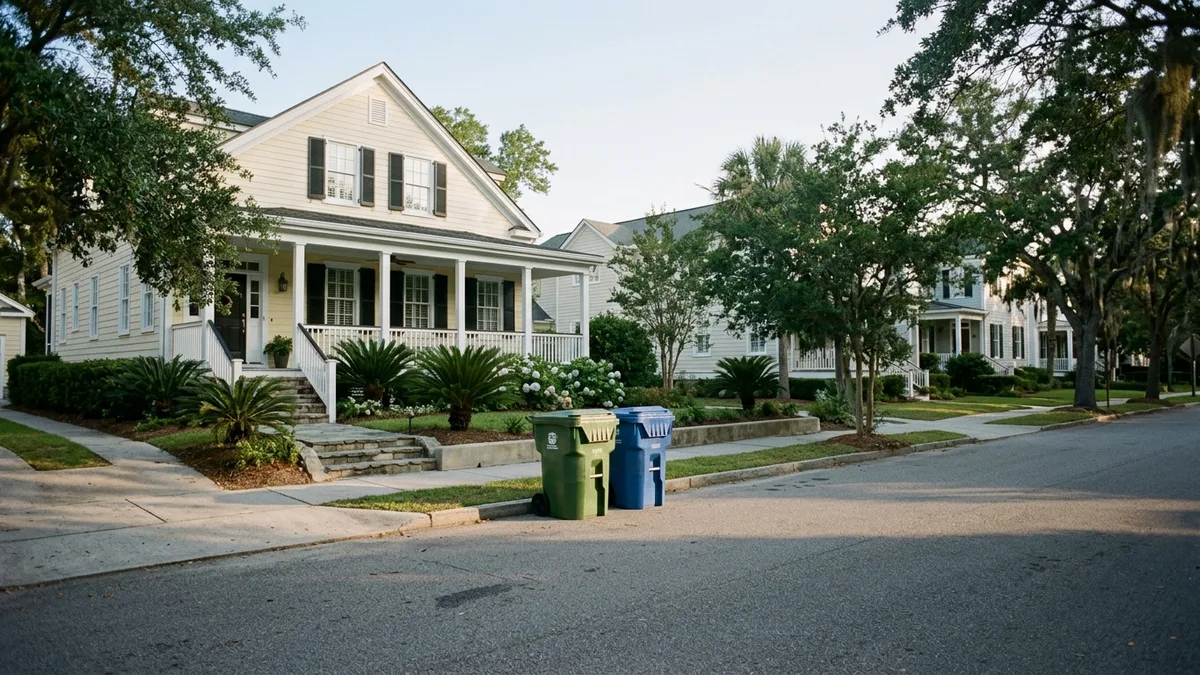
Can to curb pricing generally falls into two models: a flat monthly subscription or a per-visit charge tied to your city's collection frequency. Most residential providers price the service low enough to compete with the hassle of doing it yourself, since the alternative cost is zero dollars and just your own time.
Per-visit pricing works well for households with irregular schedules, seasonal residences, or infrequent pickup days. Flat monthly plans work better for year-round residents who want predictable billing and don't want to think about it at all. Industry research on published provider pages shows starting rates for basic can-to-curb service commonly beginning in the mid-teens per visit in some markets, though this varies significantly by region, bin count, and whether recycling is included. Trash Day Made Easy's residential valet and bin concierge service starts from $49 per month for select Charleston-area neighborhoods, which typically covers weekly bin movement without a per-visit surcharge. Multifamily, HOA, and portfolio-level pricing is quote-based because unit count, access logistics, and service frequency vary too much for a flat rate to make sense.
| Pricing Model | Best For | Typical Structure | Trade-off |
|---|---|---|---|
| Per-visit | Seasonal homes, irregular travel schedules | Charged only when service is used | Can cost more over a full year than a flat plan |
| Flat monthly | Year-round residents, HOA-mandated compliance | Fixed price regardless of visit count | Pay even during weeks you're home to do it yourself |
| Portfolio / quote-based | Multifamily, build-to-rent, scattered-site owners | Custom pricing by unit count and frequency | Requires a service consultation, not instant checkout |
Before you sign anything, ask what happens during holiday weeks when pickup shifts a day. A provider that adjusts silently is worth more than one that charges extra for a schedule change nobody controls.
Who Actually Needs Can to Curb Service?
Can to curb service solves a specific, recurring problem: someone with a trash can and a collection schedule who cannot, or would rather not, manage the physical task of moving it themselves. This covers a wider range of people than most homeowners assume.
Absentee owners are the most obvious case. If you own a second home or a rental property in Charleston, Mount Pleasant, or on Sullivan's Island and you're not physically present on trash day, someone still has to move that bin, or it sits at the curb past the ordinance window. Additionally, older homeowners or anyone with mobility limitations often find a 96-gallon bin genuinely difficult to maneuver over uneven driveways or gravel. Short-term rental operators face a different version of this problem. A guest checking out on a Tuesday has no reason to know your city's Thursday pickup schedule, let alone care about it. Property managers overseeing multiple scattered addresses across North Charleston and surrounding submarkets deal with the same challenge at scale: coordinating bin timing across a dozen properties by hand doesn't work once the portfolio grows past a handful of units.
HOA boards represent the final major use case, and arguably the one with the most community-wide impact. A single resident who forgets to bring in a bin for four days affects how the whole street looks, not just that one house.
Why Do HOA Communities Rely on Bin Management for Curb Appeal?
HOA communities depend on can to curb service because covenant enforcement around trash containers is one of the most common, and most contentious, sources of resident complaints in Charleston-area neighborhoods. A board can write a rule requiring bins to be stored out of street view within 24 hours of collection, but writing a rule and enforcing it are two different things.
Specifically, most municipal ordinances in the region, including code enforcement standards referenced by the City of Charleston and neighboring jurisdictions, restrict how long containers can remain visible at the curb after pickup. Violations create friction: the board has to notice the infraction, document it, send a notice, and often issue a fine, all for a problem that a bin management service prevents automatically. As a result, more HOA communities on James Island, Daniel Island, and throughout Summerville are building can to curb service into their community standards, sometimes as a covered amenity and sometimes as a resident opt-in. Trash Day Made Easy's trash can concierge service is designed specifically to remove this enforcement burden. Bins move on schedule regardless of what any individual resident does, which means the board spends zero time chasing compliance and residents never receive a violation notice for something they simply forgot.
This is different from the doorstep collection model used in apartment communities, where a service picks up bagged trash directly from a unit door. HOA bin management works with the resident's existing city-issued container instead of replacing the collection method entirely.
How Does Can to Curb Service Fit Short-Term Rental Operations?
Can to curb service integrates into short-term rental operations by handling bin logistics on a schedule that runs independent of guest check-in and check-out timing, which almost never aligns with a city's fixed collection day. This is one of the biggest gaps in how most people think about vacation rental waste management, and it's worth addressing directly since few providers explain it well.
A guest who checks out Sunday morning has no responsibility for, or awareness of, your city's Wednesday pickup schedule. If nobody moves the bin, trash accumulates inside the unit, overflows outdoors, or simply gets missed for the week, any of which can trigger a guest complaint or a bad review. Specifically, properties in high-turnover markets like the Charleston Historic District, Isle of Palms, and Sullivan's Island face this pressure constantly because booking calendars change week to week.
Trash Day Made Easy addresses this by pairing can to curb service with turnover trash removal for short-term rental properties, which clears out excess waste between guest stays regardless of where that timing falls relative to municipal pickup. Combining both services means an operator never has to manually track two separate schedules. For portfolios with multiple listings, this is often the difference between a smooth turnover and a same-day scramble before the next guest arrives.
What Should You Ask a Can to Curb Provider Before You Sign Up?
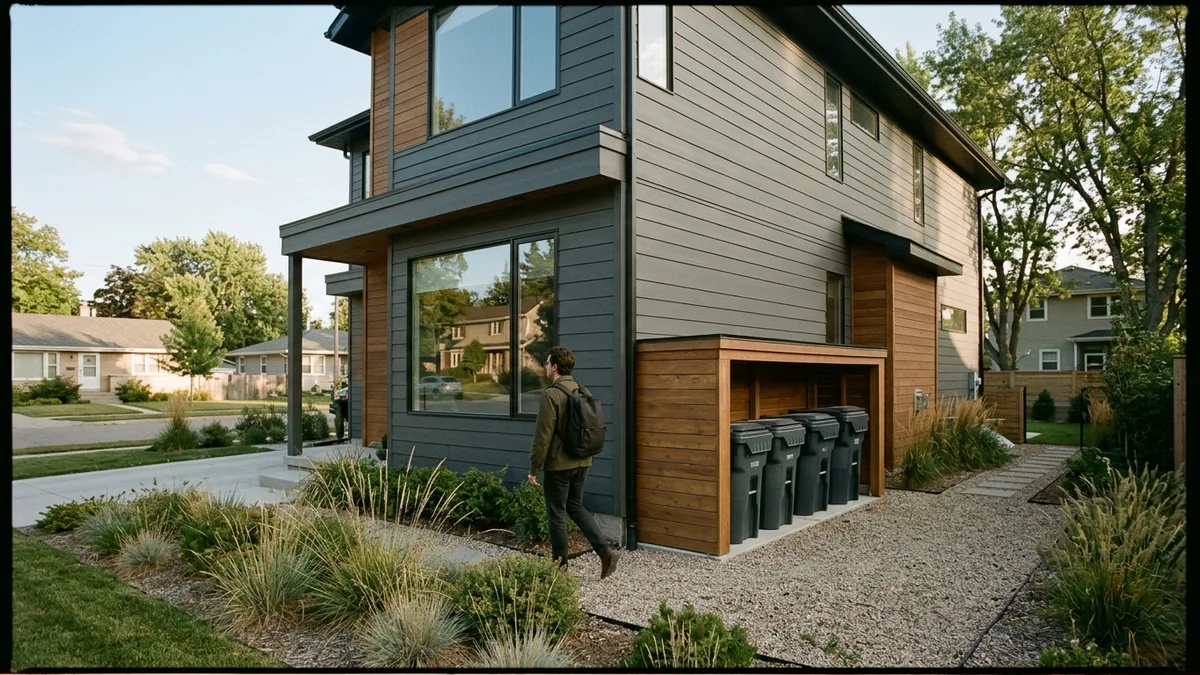
Before hiring any can to curb provider, ask how service timing adjusts around holiday pickup shifts, since municipal schedules routinely move a day during weeks with a federal holiday. A provider who can't answer this clearly is likely running the service reactively rather than on a real route schedule.
Beyond that, a short list of questions separates a reliable vendor from one that will frustrate you within the first month:
- How is service confirmed? A text message from a driver isn't the same as photo documentation of the bin actually placed at the curb.
- What happens with recycling on a separate schedule? Many municipalities run trash and recycling on alternating weeks; make sure both are covered, not just trash.
- Is pricing per-visit or flat monthly, and does it change seasonally? Ask specifically whether summer months or holiday weeks carry a surcharge.
- Can the same vendor handle bulk items or move-out debris? A one-service vendor becomes a coordination problem the moment you need anything beyond routine bin movement.
- Does the provider serve your specific neighborhood? Coverage areas within the Charleston metro vary block by block in some cases, especially in newer build-to-rent developments.
Trash Day Made Easy answers all five of these directly. Every service visit is photo-verified at the point of completion, which means property managers and homeowners get documented confirmation without ever needing to follow up or issue a reminder. The company also handles bulk item removal, move-in and move-out debris, and on-demand requests, so a resident or HOA board never needs a second vendor for anything waste-related. Service quotes are available Monday through Friday for every property type, from a single residential address to a multifamily portfolio spanning hundreds of units.
How Does Can to Curb Differ from Full Valet Trash Service?
Can to curb service and full valet trash service solve different problems, and confusing the two leads property managers to buy the wrong offering. Can to curb moves an existing municipal-issued bin to and from the curb; valet trash collects bagged waste directly from a resident's door nightly, bypassing the municipal bin entirely.
In practice, multifamily communities and larger apartment buildings tend to use nightly valet trash because residents don't have individual curb access, and dumpster corrals need consistent servicing to avoid overflow. Single-family homes, townhomes, and HOA communities where each unit has its own city-issued container are the better fit for can to curb. Build-to-rent developments often need both, since residents may have individual bins for city pickup but the property still benefits from a consolidated waste operations relationship. Trash Day Made Easy is built to serve as a single vendor across both models, offering doorstep-to-dumpster valet trash collection for multifamily settings and backdoor-to-curbside can to curb service for single-family and HOA communities, all under one photo-verified standard. That flexibility matters most for portfolio operators managing a mix of property types across Charleston and Atlanta, since understanding what valet garbage services actually include helps clarify which model fits which property.
| Feature | Can to Curb Service | Valet Trash Service |
|---|---|---|
| Container used | Resident's existing city-issued bin | Standardized bag or container at unit door |
| Best fit | Single-family homes, HOA communities, townhomes | Multifamily apartment buildings, condo complexes |
| Collection frequency | Matches municipal pickup schedule | Nightly, on a scheduled route |
| Who hauls the waste | City sanitation truck | Provider transports to dumpster or compactor |
| Typical pricing | Per-visit or flat monthly, often lower cost | Quote-based, tied to unit count |
What Do National Statistics Say About Waste Amenities in Multifamily Housing?
Valet trash and bin management amenities have become common enough in multifamily housing that industry organizations track their impact on resident satisfaction and retention. The National Apartment Association (NAA) and the National Multifamily Housing Council (NMHC) both publish research on amenity trends, including waste service adoption, that property owners and investors reference when evaluating operating budgets. Notably, the broader home services market, which includes waste and property maintenance categories, is estimated between $650 billion and $750 billion annually as of early 2026, according to industry analysis from BDR Co.'s 2026 home services trends report. As a result, waste management has increasingly shifted from a basic operational line item to a resident-facing amenity that affects lease renewal decisions in competitive rental markets like Charleston and Atlanta.
For apartment community owners and investors, this shift matters because overflowing dumpsters and inconsistent bin management directly affect how a property is perceived at renewal time. A community near the Rivers Avenue corridor competing for renters against newer builds can't afford visible waste issues dragging down curb appeal. Consistent, photo-verified service removes that variable entirely.
What Should Scattered-Site Portfolio Owners Know About Bin Management?
Scattered-site portfolio owners managing rental properties across multiple non-contiguous Charleston neighborhoods face a coordination problem that a single-property can to curb subscription was never designed to solve. Each address may sit on a different municipal pickup schedule, and managing ten or more separate vendor relationships, or worse, ten sets of tenant reminders, becomes unsustainable as a portfolio grows. The pattern we consistently see across scattered-site owners is that waste logistics get deprioritized until a tenant complaint or a code violation forces the issue. By then, the owner is troubleshooting reactively instead of running a structured program.
Trash Day Made Easy is purpose-built for exactly this scenario, capable of servicing portfolios ranging from 10 units to more than 1,000 while maintaining a consistent standard across every address. One point of contact, one photo-verification standard, and one invoice replace what would otherwise be a patchwork of city schedules and informal tenant arrangements. For owners with properties across Charleston, SC, and expanding into Atlanta, GA, that consistency is the entire value proposition.
What Are the Most Common Mistakes Property Owners Make with Bin Services?
The most common mistake we see is treating can to curb service as a convenience add-on rather than a compliance and retention tool, which leads owners to under-invest until a violation notice or a bad guest review forces a reactive decision. A few other patterns show up repeatedly:
- Choosing per-visit pricing for a year-round residence. This often costs more annually than a flat monthly plan once you add up 52 weeks of service.
- Assuming recycling is automatically included. Confirm this explicitly since many municipalities run recycling on a separate weekly or biweekly schedule.
- Not verifying service completion. Without photo confirmation, there's no way to prove service happened if a dispute arises with an HOA or a resident.
- Splitting bin management and bulk removal across two vendors. This creates scheduling gaps exactly when a portfolio needs the most coordination, like during a move-out week.
- Ignoring seasonal demand shifts. Short-term rental turnover volume in Charleston rises in summer months; a provider without on-demand flexibility can't keep pace.
Avoiding these mistakes usually comes down to picking a single vendor who documents every visit and can flex between routine and on-demand service without a separate contract.
Frequently Asked Questions
How does can to curb service work day-to-day?
A provider moves your trash and recycling bins from a backdoor or storage area to the curb ahead of your city's scheduled pickup, then returns the empty containers afterward. You never touch the bin. Trash Day Made Easy photo-verifies each visit so homeowners and property managers have documented confirmation without needing to follow up.
Is can to curb service different from full valet trash pickup?
Yes. Can to curb moves your existing city-issued bin to and from the curb for municipal pickup, while valet trash collects bagged waste directly from a resident's door nightly, typically in multifamily settings. Single-family homes and HOA communities generally use can to curb; apartment buildings typically use valet trash.
What does can to curb service cost in Charleston, SC?
Pricing varies by provider and whether you choose per-visit or flat monthly billing. Trash Day Made Easy offers residential service starting from $49 per month in select Charleston-area neighborhoods, while multifamily and portfolio pricing is quote-based due to variation in unit count and service frequency.
Can a can to curb service handle recycling too?
Most providers can manage recycling containers alongside trash, but confirm this specifically since many municipalities collect recycling on a separate weekly or biweekly schedule rather than the same day as trash. Ask any provider directly whether recycling is included in your quoted rate before signing up.
Do short-term rental owners in Charleston need can to curb service?
Short-term rental owners benefit significantly from can to curb or bundled turnover trash service because guest checkout timing rarely aligns with the municipal pickup schedule. Trash Day Made Easy pairs can to curb service with turnover trash removal for properties in high-turnover markets like the Charleston Historic District and Isle of Palms.
Can one vendor manage can to curb service across multiple rental properties?
Yes. Trash Day Made Easy is built to serve scattered-site portfolios and multifamily communities ranging from 10 units to more than 1,000, maintaining a consistent, photo-verified service standard across every address under a single vendor relationship rather than a patchwork of city schedules.
Does HOA board enforcement improve with a bin management service?
Yes. Trash can concierge service removes the enforcement burden from HOA boards because bins move on schedule regardless of individual resident compliance, eliminating the need for violation notices, fines, or reminder campaigns tied to containers left out too long.
What happens if a holiday shifts the trash pickup schedule?
A reliable provider adjusts bin placement and return timing automatically around holiday-shifted pickup days without requiring the homeowner to notify them. Ask this question directly before signing with any provider, since inconsistent holiday handling is one of the most common service failures reported by residential customers.
Conclusion: Is Can to Curb Service Worth It in 2026?
Can to curb service solves a small logistical problem that creates outsized consequences when ignored: a bin left at the curb too long, an HOA violation notice, or a guest complaint about overflowing trash. As of 2026, more Charleston-area homeowners, HOA boards, and portfolio operators are treating consistent bin management as a baseline standard rather than a luxury. Trash Day Made Easy handles this exact service across North Charleston, Charleston, and the surrounding Lowcountry, backed by photo-verified confirmation on every visit and the flexibility to scale from a single residential address to a thousand-unit portfolio. Whether you're an absentee homeowner, an HOA board tired of chasing compliance, or a portfolio owner juggling scattered addresses, the fix is the same: hand the bin logistics to a vendor who documents the job and never misses a schedule.
If you're a homeowner near Park Circle or anywhere else in the North Charleston service area tired of managing bins yourself, get started with Trash Day Made Easy for residential valet trash and trash can concierge service starting from $49 per month. Quotes are available Monday through Friday for every property type, from a single home to a full portfolio.
Content powered by inkSTR.co