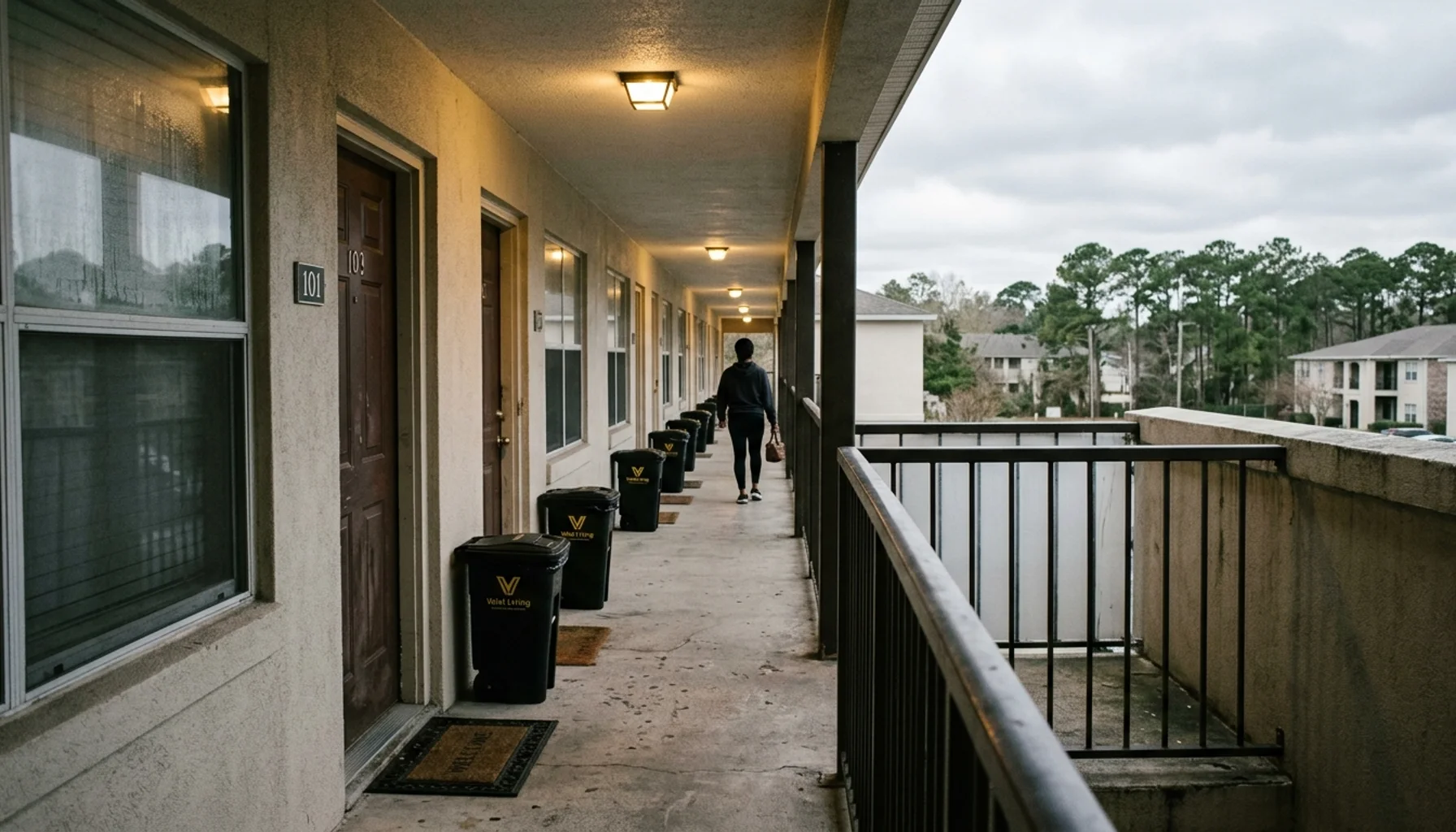
Valet trash companies typically charge property managers between $8 and $15 per unit per month, with most contracts billed against total unit count rather than occupied units. A 100 unit community can expect a provider invoice between $800 and $1,500 per month, while residents are usually billed separately for $25 to $35 per month as a line item amenity fee.
- Property-side cost: Valet trash companies charge apartments $8 to $15 per unit per month, billed on total units regardless of occupancy.
- Resident-side fee: Property managers commonly charge residents $25 to $35 per month for the amenity, creating a per-unit profit spread.
- Community size matters: Large complexes (250+ units) often negotiate closer to $8 per unit with nightly service, while smaller communities (50 to 100 units) may pay $12 or more with reduced weekly visits.
- Residential valet trash in the Charleston market starts around $49 per month per account, separate from multifamily bulk pricing.
- NOI impact is real: A 200 unit property charging $30 per unit against a $12 provider cost can generate roughly $3,600 in added monthly net operating income.
- As of 2026, valet trash remains one of the most common amenity add-ons in Charleston-area multifamily communities, driven by resident demand for convenience.
If you manage a multifamily community, a build-to-rent portfolio, or an HOA in the Charleston metro, you have probably already fielded the question: what does valet trash actually cost, and is the math worth it? At Trash Day Made Easy, we quote portfolios ranging from small 10-unit communities to properties north of 1,000 units, and the pricing conversation follows a consistent pattern every time.
The short version: what you pay a provider and what you charge residents are two separate numbers, and the gap between them is where the amenity pays for itself. This guide breaks down exactly how that math works in 2026, what drives per-unit cost up or down, and where property managers commonly get the pricing structure wrong.
You'll also find the answers to the specific questions Google users ask right after searching this topic: whether apartments can force you to pay for valet trash, what a typical trash bill runs, and how profitable the service is on the vendor side. We cover all of it with real ranges, not vague estimates.
How Much Do Valet Trash Companies Charge Apartments Per Unit?
Valet trash companies typically charge apartment properties between $8 and $15 per unit per month for standard nightly or near-nightly doorstep collection. This is the provider-side cost, meaning the invoice a property manager pays the vendor, not what residents are billed. As of 2026, this range has held fairly steady across most Southeast markets, including Charleston and Atlanta.
Specifically, pricing scales with three variables: total unit count, service frequency, and route density. A 250-plus unit community with tight, walkable breezeways is cheaper to service per door than a scattered low-density property, because a driver can hit more units per hour. Additionally, most providers bill against total units in the contract, not units currently occupied, which matters when you're budgeting during lease-up or high vacancy periods.
For example, a 100-unit property paying $12 per unit per month owes roughly $1,200 monthly regardless of whether 85 or 100 units are leased. As a result, occupancy dips do not reduce your vendor invoice, something many first-time valet trash clients don't anticipate when they sign. Understanding this billing structure up front avoids budget surprises later in the contract term.
What Do Property Managers Charge Residents for Valet Trash?
Property managers commonly charge residents between $25 and $35 per month for valet trash service, according to data compiled by Property Manager Insider and reflected across Charleston-area multifamily pricing. This resident-facing fee is typically listed as a separate line item on the monthly statement, distinct from base rent and other utility charges.
Specifically, some communities fold the fee into a broader "amenity package" alongside pest control or package lockers rather than itemizing it separately. In contrast, others make valet trash a standalone mandatory charge disclosed directly in the lease agreement. Either approach is common in the Charleston, Mount Pleasant, and North Charleston submarkets we service.
Notably, the spread between what a property pays a vendor and what it charges residents is the profit margin that makes the amenity attractive to owners. If a provider charges $12 per unit and the resident fee is $30, that's an $18 per-unit monthly margin. On a 150-unit property, that translates to roughly $2,700 in added monthly income before accounting for reduced dumpster overflow and pest control costs.
Can Apartments Force You to Pay for Valet Trash?
Yes, apartments can require valet trash as a mandatory fee if the charge is clearly disclosed in the lease agreement before signing. Whether a resident can opt out depends entirely on how the community structures the service: as a mandatory amenity fee, a bundled utility charge, or a true opt-in add-on.
In many Charleston-area communities, valet trash is written into the lease as a non-negotiable community standard, similar to how some properties mandate renters insurance or a specific internet provider. This is legal in most jurisdictions as long as the fee is disclosed clearly and consistently applied to all residents, not selectively enforced.
That said, some smaller communities and HOA-adjacent build-to-rent developments do offer valet trash as an optional upgrade, particularly in markets where residents have historically resisted mandatory fees. If you're a resident wondering whether you can decline the charge, the lease agreement is the definitive answer, not the property manager's verbal explanation. For a deeper look at how this affects renters directly, our guide on what apartment renters should know about valet trash services breaks down disclosure requirements and common lease language.
How Does Pricing Change by Community Size and Service Frequency?
Community size is one of the strongest predictors of per-unit valet trash pricing, with larger properties generally securing lower per-door rates due to route efficiency. A 250-plus unit complex can often negotiate rates near the lower end of the $8 to $15 range, while a 50 to 100 unit community typically pays closer to the upper end.
Specifically, service frequency compounds this effect. Nightly, five-to-seven-night-per-week collection costs more per stop than a three-night schedule, but it also drives higher resident satisfaction and supports a higher amenity fee. As a result, property managers weighing frequency against cost need to model both sides of the equation, not just the vendor invoice.
| Community Size | Typical Provider Cost (per unit/month) | Typical Service Frequency | Notes |
|---|---|---|---|
| 50 to 100 units | $12 to $15 | 3 to 5 nights/week | Lower route density, higher per-stop cost |
| 100 to 250 units | $10 to $13 | 4 to 6 nights/week | Most common contract tier |
| 250+ units | $8 to $11 | Nightly, 7 nights/week | Best route efficiency, lowest per-door cost |
| Premium/high-rise | $50 to $75 per door (bundled) | 6 to 7 nights/week plus staffing | Includes concierge-level service and added labor |
Notably, premium and high-rise packages that bundle valet trash with additional staffing or concierge-level service can run considerably higher, sometimes $50 to $75 per door monthly, because they include labor costs beyond simple collection. This tier is uncommon outside luxury urban high-rises and isn't representative of standard garden-style or mid-rise multifamily pricing.
How Much Is a Typical Trash Bill for an Apartment?
A typical trash bill for an apartment resident runs between $25 and $35 per month when valet trash is charged as a distinct line item, based on data from Property Manager Insider and comparable industry pricing surveys. This figure sits separately from base rent, water, and other utility charges most residents already budget for.
Specifically, some residents report paying as little as $20 per month in communities using group-rate or bundled amenity programs, while residents in premium buildings with nightly seven-day service occasionally pay $40 or more. Anecdotal reports from residents in various markets describe fees ranging from roughly $20 to $40 per month depending on the community's service tier and market.
For context, in North Charleston, where average rents in 2026 run between $1,526 for a one-bedroom and $1,889 for a studio, a $25 to $35 monthly valet trash fee represents a modest addition to overall housing cost, roughly 1.5 to 2 percent of a typical one-bedroom lease. Most residents view this as a reasonable trade for not managing bin schedules themselves, particularly in communities near the Rivers Avenue corridor where dumpster overflow has historically been a resident complaint.
How Profitable Is a Valet Trash Business?
Valet trash businesses generate profit through the spread between what they charge property owners and their own operating costs, primarily labor, fuel, and vehicle expenses. Industry cost analysis from SIB Fixed Cost Reduction shows fuel surcharges alone can add 14 to 45 percent to a waste management company's total invoice, which directly affects vendor margins and pricing decisions.
On the property owner side, profitability looks different. A 200-unit community charging residents $30 per unit against a $12 per unit provider cost nets around $18 per unit in monthly margin, or roughly $3,600 in added monthly NOI. Additionally, that same analysis notes invoice error rates near 9.5 percent industry-wide and overflow fees ranging from $125 to $260 per occurrence, both of which erode vendor-side profitability if operations aren't tightly managed.
From our vantage point at Trash Day Made Easy, the pattern we consistently see is that operators who treat photo verification and route discipline as non-negotiable tend to run leaner, more profitable operations than those relying on driver self-reporting. Skipping documentation might save a few minutes per stop, but it creates dispute costs and re-service trips that eat into margin fast.

How Does Trash Actually Get From the Door to the Dumpster?
Door-to-dumpster valet trash collection is a routed, scheduled process where crews walk or drive designated paths through a community, collecting bagged waste from each unit's doorstep and consolidating it at a central compactor or dumpster location. This workflow, largely absent from most pricing guides, is exactly what determines whether a provider can hit the $8 per unit rate or needs to charge closer to $15.
Specifically, routes are built around building layout. A garden-style community with exterior breezeways allows a two-person crew to service 150 to 200 doors per shift, typically between 6 p.m. and 8 p.m., Sunday through Thursday, according to standard industry scheduling patterns. In contrast, high-rise properties require elevator time and interior hallway routing, which slows throughput and raises per-door labor cost. Each unit is typically provided a standardized 13-gallon receptacle, and crews replace liners nightly as part of the service. As a result, staffing models usually run one crew member per 100 to 150 units on a given route, with route supervisors periodically auditing for missed stops. Photo verification at each door has become the industry standard for confirming a stop was completed, giving property managers a documented record rather than a verbal assurance that service happened.
In-House Valet Trash vs. Third-Party Providers: Which Costs Less?
In-house valet trash programs, where a property hires and manages its own collection staff directly, can appear cheaper on paper but usually carry hidden costs that third-party contracts avoid. Specifically, in-house programs require the property to absorb liability insurance, staffing turnover, vehicle maintenance, and supervision, none of which show up in a simple per-unit labor estimate. Third-party providers like the model Trash Day Made Easy uses spread these fixed costs across an entire portfolio or client base, which is why contracted per-unit rates of $8 to $15 often beat what a single property would pay to run the program itself. Additionally, third-party vendors typically carry their own liability coverage and staffing redundancy, so a call-out doesn't mean missed service that night. The trade-off works in the other direction for extremely large single-site properties, such as a 500-plus unit high-rise with dedicated on-site maintenance staff already covering some overlapping duties. In that narrow case, blending a partial in-house model with contracted overflow support can occasionally undercut a fully outsourced contract. For most communities under 500 units, and especially for scattered-site portfolios spanning multiple Charleston-area neighborhoods, a single contracted vendor relationship is almost always the more cost-predictable choice.
Can Residents Negotiate or Opt Out of Valet Trash Fees at Lease Renewal?
Residents have limited but real negotiating room on valet trash fees, and the leverage point is almost always lease renewal, not mid-lease. Specifically, if a lease designates the fee as mandatory and non-negotiable, a resident's only real option is raising the issue directly with the property manager before signing a renewal, framing it as a retention conversation rather than a service complaint. In practice, some property managers will waive or discount the fee for long-term residents renewing during periods of higher vacancy, treating it as a concession similar to a rent credit. This is more common in markets with softer demand; it's far less likely in tight submarkets like Daniel Island or Park Circle, where 2026 lease-up times have stayed brisk at around 16 days according to Charleston Metro Rental Market Report data. Residents in communities where valet trash is structured as a true opt-in amenity, rather than a mandatory lease line item, have more straightforward standing to decline the service entirely. Before signing any lease, ask directly whether the fee is mandatory, bundled, or optional, and get the answer in writing rather than relying on a leasing agent's verbal explanation.
What Should Property Managers Ask Before Signing a Valet Trash Contract?
Before signing, property managers should confirm exactly how the provider bills, verifies service, and handles missed pickups, since these three factors determine whether the quoted per-unit rate holds up over the contract term. A low quote with no service verification often costs more in resident complaints and re-service calls than a slightly higher quote with documented accountability.
- Ask how billing is structured. Confirm whether you're billed on total units or occupied units, and whether pricing adjusts as your portfolio grows or shrinks.
- Ask how service completion is verified. Photo-verified service at each door, rather than driver self-reporting, gives you a documented record without needing to follow up on every complaint.
- Ask about service frequency flexibility. Confirm whether you can adjust from nightly to reduced-frequency service seasonally, and how that affects your rate.
- Ask how bulk items and turnover waste are handled. Standard valet trash contracts often exclude bulk removal; confirm whether that's a separate service or add-on.
- Ask about portfolio scalability. If you manage multiple properties across Charleston, North Charleston, or Atlanta, confirm the provider can maintain consistent standards across every location, not just your flagship property.
- Ask about contract length and rate lock terms. Confirm whether fuel surcharges or other add-on fees can be applied mid-contract without notice.
At Trash Day Made Easy, we build every quote around these exact questions, because portfolio operators managing properties from North Charleston to Atlanta have told us directly that inconsistent verification, not price, was the reason they left a previous vendor. If you're evaluating a scattered-site portfolio, our overview of multifamily waste management services covers how a single-vendor relationship holds up across dozens of properties.
What's the Real NOI Impact of Adding Valet Trash to a Property?
Valet trash adds measurable net operating income to a multifamily property by creating a fee spread between what residents pay and what the provider charges, while also reducing ancillary costs tied to dumpster overflow and pest issues. A 200-unit property charging residents $30 per unit against a $12 per unit provider cost generates roughly $3,600 in additional monthly NOI, as shown in the pricing table above.
Specifically, this spread compounds over a full year. That same 200-unit example produces over $43,000 in annual NOI contribution from the amenity fee spread alone, before factoring in reduced dumpster hauling frequency or lower pest control incidence, both of which valet trash programs commonly improve. Additionally, industry data indicates valet trash usage rates run high among residents in communities where it's offered, supporting the case that it functions as a retention driver, not just a revenue line.
For property managers weighing whether the amenity justifies a rent bump versus a standalone fee, the data suggests either approach works, provided the resident charge stays within the commonly observed $25 to $35 range. Charging meaningfully above that band without added service tiers, like bin cleaning or bulk pickup, risks resident pushback at renewal.
Comparing Provider Cost vs. Resident Fee: A Quick Reference Table
The table below summarizes how valet trash pricing typically breaks down by property size, giving property managers a fast reference for budgeting conversations with ownership or investors.
| Property Size | Provider Cost/Unit | Resident Fee/Unit | Est. Monthly Margin |
|---|---|---|---|
| 100 units | $10-$15 | $25-$35 | $1,000-$2,000 |
| 150 units | $10-$13 | $28-$33 | $2,250-$3,000 |
| 200 units | $8-$12 | $30 | $3,600 |
| Residential (Charleston, single-family) | N/A (flat rate) | $49-$70/month | N/A |
Notice the residential row looks different from multifamily pricing entirely. Residential valet trash in select Charleston neighborhoods runs on a flat monthly rate rather than a per-unit spread model, starting from $49 per month for standard weekly bin roll-out and rising to around $70 per month for plans that include bin cleaning. If you're comparing residential options, our guide to can to curb services in the Charleston market walks through how that pricing model differs from the multifamily structure covered above.
What Mistakes Do Property Managers Make When Budgeting for Valet Trash?
The most common mistake property managers make is budgeting valet trash against occupied units instead of total units, which creates a shortfall the moment occupancy dips below full. Since most provider contracts bill on total unit count, a property running at 90 percent occupancy still owes the full invoice, not a prorated amount.
A second frequent error is treating bulk item removal and turnover trash as automatically included in a standard valet trash contract. In our experience, these are almost always separate line items or add-on services, particularly during high-turnover seasons when move-out debris spikes. Our piece on Lowcountry junk removal for property turnovers covers what to expect when a unit turns over with leftover furniture or debris.
- Not confirming photo verification. Without it, disputes over missed service become a he-said-she-said situation.
- Ignoring fuel surcharge clauses. Contracts can add 14 to 45 percent to the base invoice through surcharges not disclosed clearly upfront.
- Underpricing the resident fee. Setting the charge below $25 per unit leaves little margin once provider costs and overhead are factored in.
- Overlooking portfolio consistency. Using different vendors across scattered-site properties creates service gaps and inconsistent resident experience.
Property managers overseeing build-to-rent communities near Daniel Island or the airport corridor face an added wrinkle: dispersed residents across single-family layouts don't share hallways or breezeways the way traditional apartments do, which changes route logistics and, in some cases, per-unit pricing. Our build-to-rent waste management overview addresses how that layout difference factors into service design.
Frequently Asked Questions
How much do valet trash companies charge apartments per unit?
Valet trash companies typically charge property managers between $8 and $15 per unit per month, depending on community size and service frequency. Larger communities of 250-plus units often secure rates near the lower end due to route efficiency, while smaller communities of under 100 units typically pay closer to the higher end.
Can apartments force you to pay for valet trash?
Yes, if the fee is clearly disclosed as mandatory in the lease agreement before signing, apartments can require valet trash as a non-negotiable charge. Some communities instead offer it as an opt-in amenity, so the answer depends entirely on how a specific lease structures the fee.
How much do property managers charge residents for valet trash?
Property managers commonly charge residents between $25 and $35 per month for valet trash service, based on data from Property Manager Insider. Some communities bundle this into a broader amenity fee rather than listing it as a standalone charge.
How profitable is a trash valet business?
Profitability depends on operating costs like fuel and labor, which can add 14 to 45 percent to a provider's total invoice through surcharges. On the property side, a 200-unit community charging residents $30 per unit against a $12 provider cost can generate roughly $3,600 in monthly net margin.
Does a bigger apartment community get a better valet trash rate?
Generally yes. Larger communities with 250 or more units typically negotiate per-unit rates closer to $8 to $11, since route density allows crews to service more doors per shift. Smaller communities under 100 units usually pay $12 to $15 per unit due to lower route efficiency.
Is valet trash included in apartment rent, or is it a separate fee?
It varies by community. Some properties bundle valet trash into a broader amenity fee or into base rent, while others itemize it as a distinct monthly charge, typically $25 to $35. Always check the lease agreement for exact fee structure before signing.
What does residential valet trash cost outside of apartment communities?
Residential valet trash service for single-family homes in the Charleston market typically starts around $49 per month for standard weekly bin roll-out, with premium plans that include bin cleaning reaching about $70 per month. This differs from the multifamily per-unit spread pricing model used in apartment communities.
Does valet trash pricing include bulk item or move-out waste removal?
Usually not automatically. Standard valet trash contracts typically cover nightly doorstep bag collection only, while bulk item removal, move-in and move-out debris, and turnover trash are commonly billed as separate on-demand services.
Conclusion: What to Budget for Valet Trash in 2026
Valet trash companies charge apartments between $8 and $15 per unit per month on the provider side, while property managers typically pass along a resident fee of $25 to $35 per month, creating a margin that supports both amenity value and added NOI. As of 2026, this pricing structure has remained consistent across the Charleston and Atlanta markets, and demand for the amenity continues to grow alongside resident expectations for hands-off convenience.
Getting the math right means understanding that provider cost, resident fee, and service verification are three separate decisions, not one line item. Property managers who budget against total units, confirm photo-verified service, and account for bulk item removal separately avoid the most common pricing missteps we see across portfolios in North Charleston, Mount Pleasant, and beyond.
Trash Day Made Easy provides nightly, photo-verified valet trash service for multifamily communities and property portfolios across Charleston and Atlanta, scaling from 10 units to more than 1,000. If you're ready to get a clear, portfolio-specific quote instead of guessing at industry averages, get started with Trash Day Made Easy, with quotes available Monday through Friday for every property type.

If you manage a residential property in a select Charleston neighborhood rather than a multifamily community, Trash Day Made Easy's residential valet trash service starts from $49 per month, with a premium option that adds bin cleaning through our partnership with The Bin Boy. Request a quote here to see exact pricing for your address.
Content powered by inkSTR.co