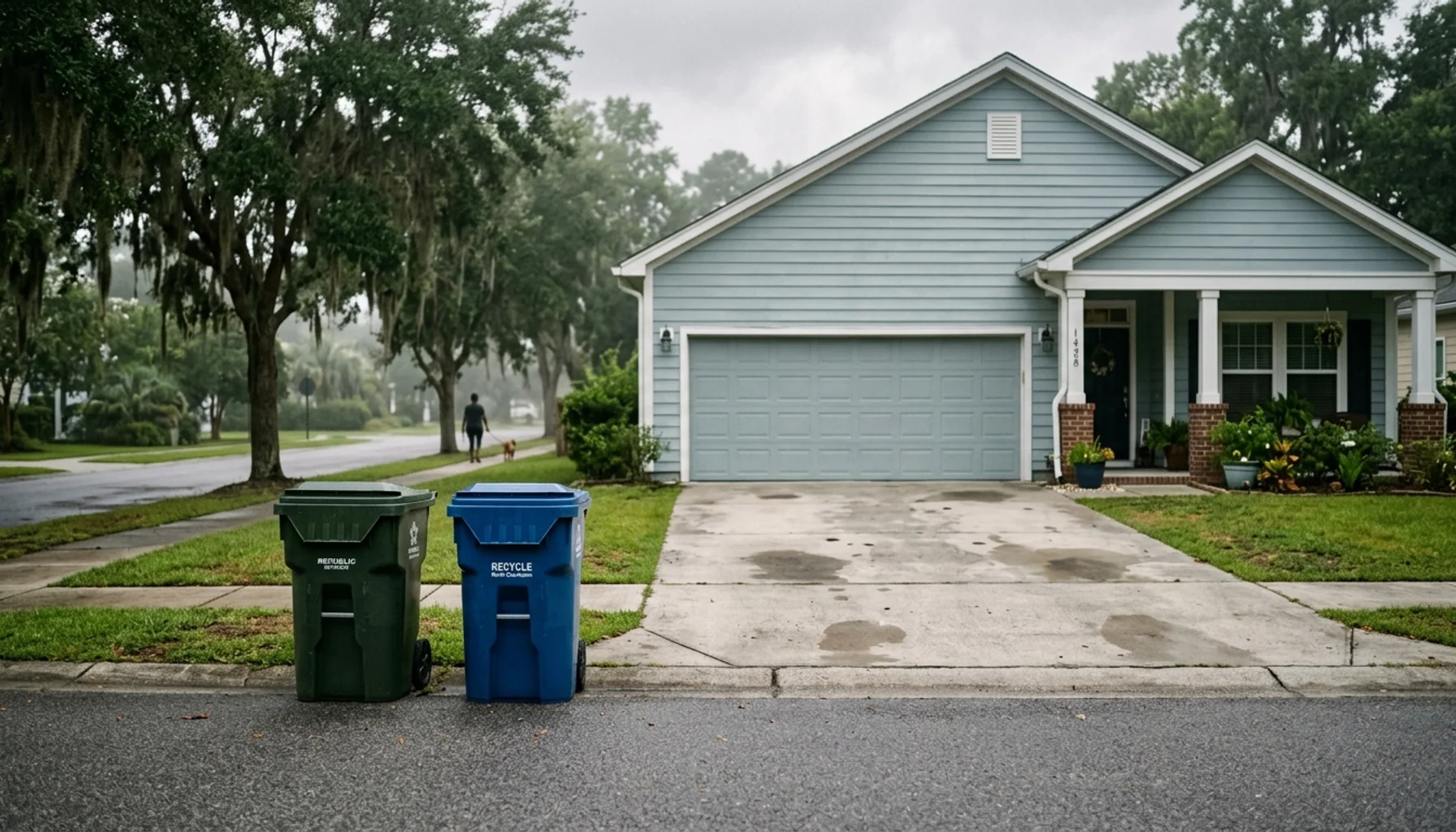
Trash can to curb service is a subscription program where a local provider rolls your trash and recycling bins from your house or side yard to the curb before pickup day, then returns them to storage after the truck empties them. Charleston-area rates typically run from around $16 per visit to roughly $40 to $50 per month, depending on the number of cans and how often the service runs.
TL;DR: Trash Can to Curb Service Basics
- What it is: A provider moves your bin from its storage spot to the curb before your scheduled municipal pickup, then returns it, so you never touch it.
- Typical cost: Industry pricing generally falls between $16 per visit and $50 per month, depending on can count, frequency, and driveway distance.
- Who uses it: Homeowners who travel often, seniors, short-term rental hosts, and HOA communities trying to reduce curb-appeal violations.
- Charleston specifics: The City of Charleston collects residential garbage once weekly from a standard 96-gallon container, while North Charleston runs its own separate sanitation schedule, so your provider needs to know both.
- What to check before signing up: Confirm insurance coverage, photo-verification of completed service, and whether the plan covers holiday schedule changes automatically.
- Trash Day Made Easy's approach: Residential valet trash and trash can concierge service starts from $49 per month in select Charleston neighborhoods, with photo-verified proof at every visit.
What Is Trash Can to Curb Service?
Trash can to curb service is a recurring, paid arrangement in which a third-party crew handles the physical labor of putting your trash and recycling bins out for pickup and bringing them back afterward. It exists specifically to remove the weekly chore of remembering trash day, dragging heavy bins down a driveway, and retrieving them after the truck has passed.
The service does not replace your municipal garbage collector. Instead, it works alongside whichever agency already picks up your waste, whether that is the City of Charleston Environmental Services department or the City of North Charleston Public Works Sanitation Division. The provider simply becomes the middle step between your storage area and the curb.
For homeowners in Mount Pleasant, James Island, and Summerville, this distinction matters because collection days and container rules differ block by block. A competent local provider tracks each household's specific pickup day, container size, and any holiday schedule shifts, so you're never the one checking a calendar.
Most plans fall into two structures: one-way service, where the crew only brings the can back after pickup, and two-way service, where they handle both the outbound and return trip. Two-way plans dominate the market because they solve the entire chore, not half of it.
How Much to Charge for Trash Valet?
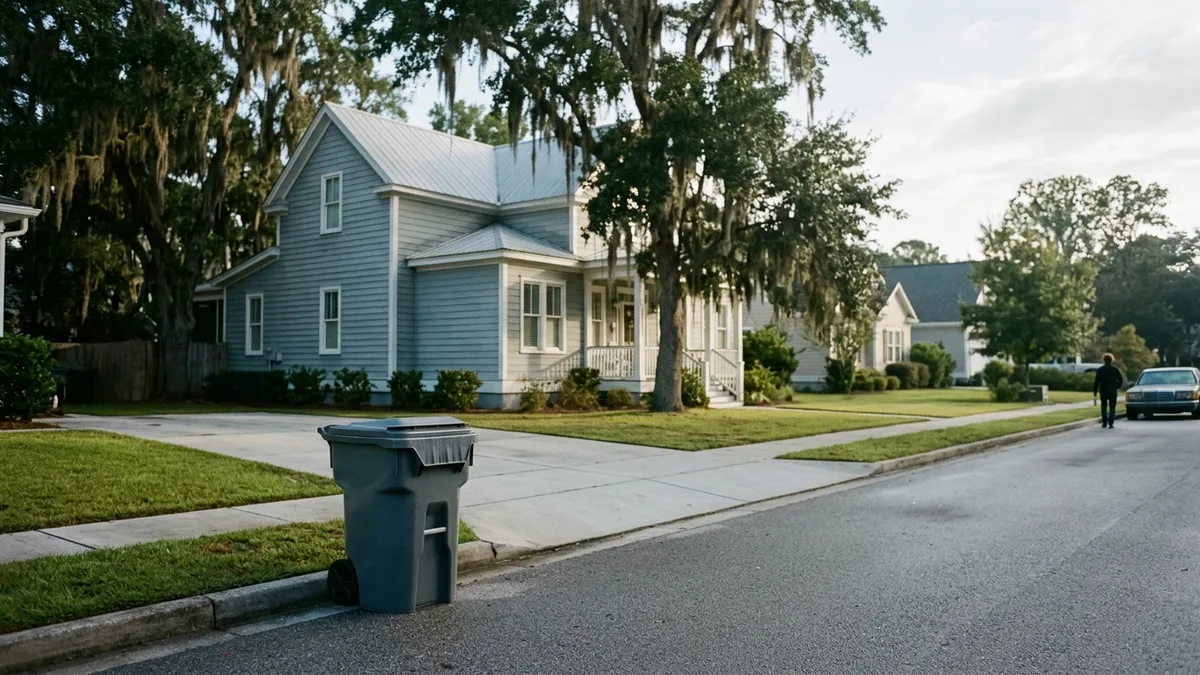
Valet trash pricing for multifamily properties generally runs between $8 and $15 per unit per month for the property, while residents typically pay somewhere in the $25 to $35 per month range when the cost is passed through directly, according to industry pricing data compiled in 2026. Can to curb pricing for single-family homes follows a different model entirely, since it's billed per household rather than per unit.
For residential can to curb service specifically, published rates across the industry commonly range from about $16 per visit up to roughly $50 per month, with variation driven by can count, weekly frequency, and driveway length. Some providers charge a flat monthly fee regardless of how many times a truck comes, while others price per collection day, which adds up fast for twice-weekly commercial-style pickup.
Additional cans usually add a modest per-can fee on top of the base rate. Long driveways, gated communities, and properties with restricted access sometimes carry a surcharge because they add time to each stop on a route.
Trash Day Made Easy's residential valet trash and trash can concierge service starts from $49 per month in select Charleston neighborhoods, which sits squarely within the range documented across the broader can to curb industry. Multifamily communities, build-to-rent developments, and portfolio operators receive custom quotes rather than flat residential pricing, since unit count, access points, and service frequency all shift the math. Quotes are available Monday through Friday by contacting Trash Day Made Easy directly.
What Drives the Price Up or Down
- Number of cans: Trash-only service costs less than trash plus recycling plus yard debris.
- Frequency: Weekly service is standard for residential; twice-weekly plans cost more.
- Access: Long driveways, steep grades, or locked gates add labor time per stop.
- Contract length: Month-to-month plans sometimes carry a slightly higher rate than annual commitments, though flexibility is often worth the trade-off for seasonal residents.
Where to Put Trash Can on Curb?
Correct curb placement means positioning the container within about 2 feet of the curb line, with the handle facing away from the street, and keeping at least 3 feet of clearance from mailboxes, trees, parked cars, and other containers. Getting this wrong is one of the most common reasons a truck skips a can entirely.
Timing matters as much as positioning. Containers generally should not go out before 6 p.m. the evening before your scheduled pickup and should come back in by 6 p.m. on pickup day itself, per standard municipal guidance followed across the Charleston region. Leaving a can at the curb longer than that is a frequent trigger for HOA violation notices in communities on James Island, Daniel Island, and throughout Mount Pleasant.
Automated collection trucks use a robotic arm that grabs the container from the side, so improper orientation or overcrowding around the bin can cause a missed pickup that then sits until the following week. This is precisely the failure point that trash can to curb service is designed to eliminate: a trained crew places every bin the same correct way, every time, regardless of who's home or whether anyone remembered what day it is.
For residents managing multiple containers, such as a 96-gallon garbage cart plus a separate recycling bin, spacing them correctly becomes even more important. A crowded curb confuses automated arms and slows the entire block's collection.
Can the Trash Truck Skip My House If the Can Isn't Positioned Right?
Yes, automated and semi-automated collection vehicles regularly skip containers that are placed too close to obstructions, facing the wrong direction, or set out after the truck's route has already passed. This single mechanical reality is why placement precision matters more than most homeowners assume.
Specifically, a can pushed against a mailbox post or parked directly behind a neighbor's overflowing bin often gets bypassed rather than serviced late. Once missed, that household typically waits until the next scheduled collection day, sometimes a full week, before the container is emptied again.
As a result, homeowners who travel frequently or who physically can't manage bin placement face repeated missed weeks. A trash can to curb provider eliminates this risk by training crews on exact placement standards and confirming each stop was completed correctly, often through photo documentation sent back to the homeowner or property manager.
Do Providers Handle Holiday Schedule Changes Automatically?
Holiday schedule adjustments shift collection days across both the City of Charleston and City of North Charleston several times per year, and a quality trash can to curb provider tracks these changes so the homeowner never has to. This is one of the more overlooked value points of paying for the service at all.
Both municipalities publish modified pickup calendars around major holidays, pushing collection by a day for the remainder of that week. Homeowners managing their own bins frequently miss these shifts, leaving a full can at the curb on the wrong day or, worse, missing the correct day entirely.
A provider that actively monitors municipal calendars for North Charleston, Charleston, Mount Pleasant, and surrounding Charleston County service areas builds holiday adjustments directly into its own routing. This is a differentiator worth asking about directly when vetting any local company; not every provider updates its schedule proactively, and a static, unmonitored routine defeats the purpose of outsourcing the chore in the first place.
Trash Can to Curb Service vs. Full Valet Trash: What's the Difference?
Trash can to curb service and full valet trash service solve related but distinct problems, and understanding the difference determines which one actually fits your property. Can to curb service is a backdoor-to-curbside model built for single-family homes and HOA communities, where a resident's own municipal container gets moved to the street and returned. Full valet trash, by contrast, is a doorstep-to-dumpster model built for multifamily apartment communities, where residents place bags directly outside their unit door for nightly pickup.
The table below breaks down how the two models compare across the factors that matter most when choosing between them.
| Factor | Trash Can to Curb Service | Full Valet Trash Service |
|---|---|---|
| Best for | Single-family homes, HOA communities, residential homeowners | Apartment communities, multifamily portfolios, build-to-rent developments |
| Collection point | Backdoor or storage area to curb, and back | Resident's doorstep to dumpster or compactor |
| Frequency | Typically weekly, matched to municipal pickup day | Nightly, several times per week |
| Container | Homeowner's existing 96-gallon municipal cart | Standardized bin, commonly around 13 gallons |
| Typical pricing | Roughly $16 per visit to $50 per month | Roughly $8 to $15 per unit for the property; $25 to $35 per resident |
| Who pays | Homeowner directly | Often billed through property management or passed to residents |
Trash Day Made Easy runs both models under one company, which matters for HOA communities that include a mix of single-family homes and townhome clusters, and for build-to-rent developments near Daniel Island and the airport corridor that want one vendor relationship instead of two separate contracts. For a deeper breakdown of the multifamily side, see this guide to valet garbage services for property managers.
How Do You Vet a Local Can to Curb Provider?
Vetting a can to curb provider means confirming insurance coverage, verifying a documented service-completion process, and asking direct questions about what happens when a truck misses a can, before signing any agreement. This is the step most homeowners skip, and it's the exact gap most competitor content in this space never addresses.
Specifically, ask whether the provider carries general liability insurance in case a bin is damaged or a driveway is scratched during service. Ask how the company confirms a visit actually happened; a provider that simply promises "we did it" without documentation leaves you with no recourse if pickup gets skipped.
Additionally, ask what happens if the municipal truck skips your can due to overflow, contamination, or a mechanical issue. A provider with a clear escalation process, such as flagging the missed pickup and rescheduling or notifying you directly, is more trustworthy than one with no defined response.
Notably, Trash Day Made Easy documents every single service stop with a photo, giving homeowners and property managers the same accountability layer that multifamily clients receive across the company's doorstep trash collection operations. That documentation habit is worth demanding from any provider you're considering, not just this one.
Red Flags to Watch For
- No written confirmation of completed service, photo or otherwise
- Vague answers about liability coverage or damage responsibility
- No clear plan for holiday schedule changes
- Contracts that lock you in for a full year with no cancellation option
- Pricing that seems dramatically lower than the documented industry range without explanation
Should You Outsource Bin Management or Hire a Neighbor?
Outsourcing to a professional trash can to curb provider makes more sense than an informal arrangement whenever reliability, documentation, or liability protection matter more than saving a small amount of money each month. Hiring a neighbor's teenager for a flat monthly fee is common in some Charleston-area neighborhoods, but it comes with trade-offs worth weighing honestly.
An informal arrangement has no backup plan. If the neighbor is on vacation the same week you are, your can doesn't move. There's no insurance if a bin gets damaged, no photo confirmation, and no accountability if the job simply doesn't happen one week.
A professional provider solves each of these gaps. Routes continue regardless of individual availability, service is documented, and liability coverage protects both parties. For homeowners in HOA communities where a missed pickup can trigger a violation notice, that reliability difference has real financial weight; a single fine can exceed months of service fees.
For seasonal residents or hosts managing a short-term rental near Isle of Palms or Sullivan's Island, the calculus tilts even further toward professional service, since the property may sit empty for stretches with no neighbor around to notice a missed can at all.
What Smells Keep Maggots Away From Trash Cans?
Keeping bins clean and dry is the most effective way to prevent maggots, since fly larvae need moist organic material to survive, not any particular smell to avoid. That said, certain scents genuinely disrupt fly activity around cans: white vinegar, diluted bleach, and essential oils like peppermint or eucalyptus are commonly used as natural deterrents because flies avoid strong, sharp odors when choosing where to lay eggs.
Regularly rinsing cans, especially in Charleston's humid summer climate, removes the residue that attracts flies in the first place. A can that sits unwashed for months in coastal heat becomes a breeding ground regardless of what deterrent spray gets used afterward.
This is where bin cleaning becomes a meaningful add-on to can to curb service rather than an afterthought. Trash Day Made Easy partners with The Bin Boy, a Charleston-based bin cleaning and sanitizing service, so homeowners can combine weekly curb service with periodic deep cleaning, addressing odor and pest issues at the source instead of masking them.
Can the Police Search My Trash Can If I Push It to the Curb for Pickup?
Once a trash container is placed at the curb for collection, it's generally considered abandoned property under longstanding legal precedent, meaning law enforcement typically does not need a warrant to search it. This principle traces back to the U.S. Supreme Court's 1988 ruling in California v. Greenwood, which established that individuals have no reasonable expectation of privacy in trash left for collection in a publicly accessible area.
This is a matter of general legal knowledge, not something specific to any Charleston-area municipality, and homeowners should understand it applies broadly across the country. It has no bearing on whether a professional can to curb provider is trustworthy; the legal exposure exists the moment a bin reaches the curb regardless of who moved it there.
Practically speaking, this rule rarely affects everyday homeowners using trash can to curb service. It's a commonly searched question, but it doesn't change how the service works or what a provider is responsible for.
What Should You Prioritize When Choosing a Provider?
Choosing the right trash can to curb provider comes down to four factors: documented service completion, insurance protection, schedule reliability across holidays, and how the company handles multi-can or multi-property needs. Price matters, but it should never be the only factor, since the cheapest option often skips the accountability layer that makes the service worth paying for at all.
- Confirm documentation. Ask specifically whether service completion is confirmed with a photo, and how quickly you'd know if a stop was missed.
- Check insurance. Request proof of general liability coverage before signing, especially if you have a long or narrow driveway.
- Ask about holiday handling. A provider should proactively adjust for City of Charleston and North Charleston holiday schedule shifts without you having to remind them.
- Clarify container scope. Confirm whether the plan covers trash only, or trash plus recycling and yard waste, since North Charleston does not collect yard waste in plastic bags.
- Understand the contract terms. Favor month-to-month flexibility over long lock-in periods, particularly if you're a seasonal resident or short-term rental host.
Other options in the market include CanMonkey, TrashDash, Can Concierge, Timely Trash Services, and Trash Can Valet. Trash Day Made Easy, based at 4900 O'Hear Avenue in North Charleston, builds trash can concierge service alongside full valet trash, bulk item removal, and portfolio-scale waste operations, so homeowners, HOA boards, and property managers can work with a single local vendor instead of stitching together several.
How Does This Work for HOA Communities and Short-Term Rentals?
HOA communities and short-term rental operators both benefit from trash can to curb service for the same underlying reason: neither wants an unreliable resident or absent guest turning into a curb-appeal or compliance problem. For HOA boards on James Island and Daniel Island, enforcement of container timing rules is often the single most time-consuming complaint category volunteers deal with.
A structured service removes the enforcement burden entirely. Bins move on schedule regardless of whether a homeowner is traveling, working late, or simply forgot. HOA boards enforce nothing because there's nothing left to enforce.
For short-term rental operators near the Charleston Historic District, Isle of Palms, and Sullivan's Island, the stakes are different but the solution is the same. A guest arriving to find last week's trash still at the curb, or a bin left blocking the driveway, generates a bad review fast. Pairing can to curb service with turnover trash removal for property turnovers keeps a rental presentable between every guest, not just on the days someone happens to check.
Scattered-site portfolio owners managing properties across North Charleston, Summerville, and Johns Island face a related challenge: coordinating multiple individual homeowner schedules across non-contiguous addresses. A single vendor relationship, rather than a patchwork of city pickup dates and informal helpers, is the only approach that scales cleanly as a portfolio grows past a handful of properties.
Frequently Asked Questions
How much does trash can to curb service cost per month?
Industry pricing generally ranges from about $16 per visit to roughly $50 per month, depending on the number of cans, collection frequency, and driveway distance. Trash Day Made Easy's residential valet trash and trash can concierge service starts from $49 per month in select Charleston neighborhoods.
What's the difference between trash can to curb service and valet trash service?
Can to curb service moves your own municipal container from storage to the street and back, built for single-family homes and HOA communities. Valet trash service collects bagged waste directly from an apartment doorstep to a dumpster or compactor, built for multifamily communities with nightly pickup schedules.
Do I need to provide my own trash can for this service?
Yes, in most cases the provider moves your existing municipal container, such as the 96-gallon cart most City of Charleston residential customers already use. The service does not typically supply a new bin; it manages the one your municipality assigned to your address.
What happens if the trash truck misses my can?
A reliable provider should flag the missed pickup, confirm whether it was due to placement, overflow, or a mechanical issue, and either reschedule or notify you directly. This is one of the most important questions to ask before signing with any local company, since not every provider handles missed pickups the same way.
Can trash can to curb service handle recycling and yard waste too?
Many providers offer plans covering trash, recycling, and yard waste together, though coverage varies by company. Note that North Charleston only collects yard waste in paper bags for curbside pickup, so confirm your provider follows that requirement rather than using plastic bags that won't be collected.
Is trash can to curb service worth it for seniors or frequent travelers?
For homeowners who are physically unable to manage heavy bins or who travel frequently, professional can to curb service removes a recurring physical chore and eliminates the risk of missed pickups while away. It also avoids the accountability gaps that come with relying on an informal neighbor arrangement.
Does Trash Day Made Easy offer bin cleaning in addition to can to curb service?
Yes. Trash Day Made Easy partners with The Bin Boy, a Charleston-based bin cleaning and sanitizing service, so homeowners can pair weekly curb service with periodic bin sanitizing to address odor and pest concerns at the source.
Can one provider handle can to curb service for an entire HOA or portfolio of homes?
Yes. Trash Day Made Easy is built to scale from a single residential homeowner up to multifamily and scattered-site portfolios of 10 to more than 1,000 units, giving HOA boards and portfolio owners one point of contact and consistent service standards across every address.
The Bottom Line on Trash Can to Curb Service
Trash can to curb service solves a chore that seems small until you're the one dragging a 96-gallon cart down a long driveway in July heat, or explaining to an HOA board why your bin sat at the curb three days too long. Industry pricing across the market runs from roughly $16 per visit to about $50 per month, and the providers worth paying for are the ones who document every visit and adjust automatically for holiday schedule shifts.
For Charleston-area homeowners, HOA communities, and short-term rental operators, the decision isn't really whether to outsource; it's who to trust with it. Trash Day Made Easy combines residential trash can concierge service starting from $49 per month with the same photo-verified accountability standard used across its multifamily and build-to-rent portfolio work, all run from its North Charleston headquarters.
As 2026 continues to bring more households toward outsourced home services, trash can to curb service has moved from a niche convenience to a mainstream expectation in Charleston-area neighborhoods where curb appeal and HOA compliance carry real weight.

If you're tired of remembering trash day yourself, Trash Day Made Easy's residential trash can concierge service handles the whole cycle, from storage to curb and back, with photo confirmation sent after every visit. Request a quote at Trash Day Made Easy, available Monday through Friday.
Content powered by inkSTR.co