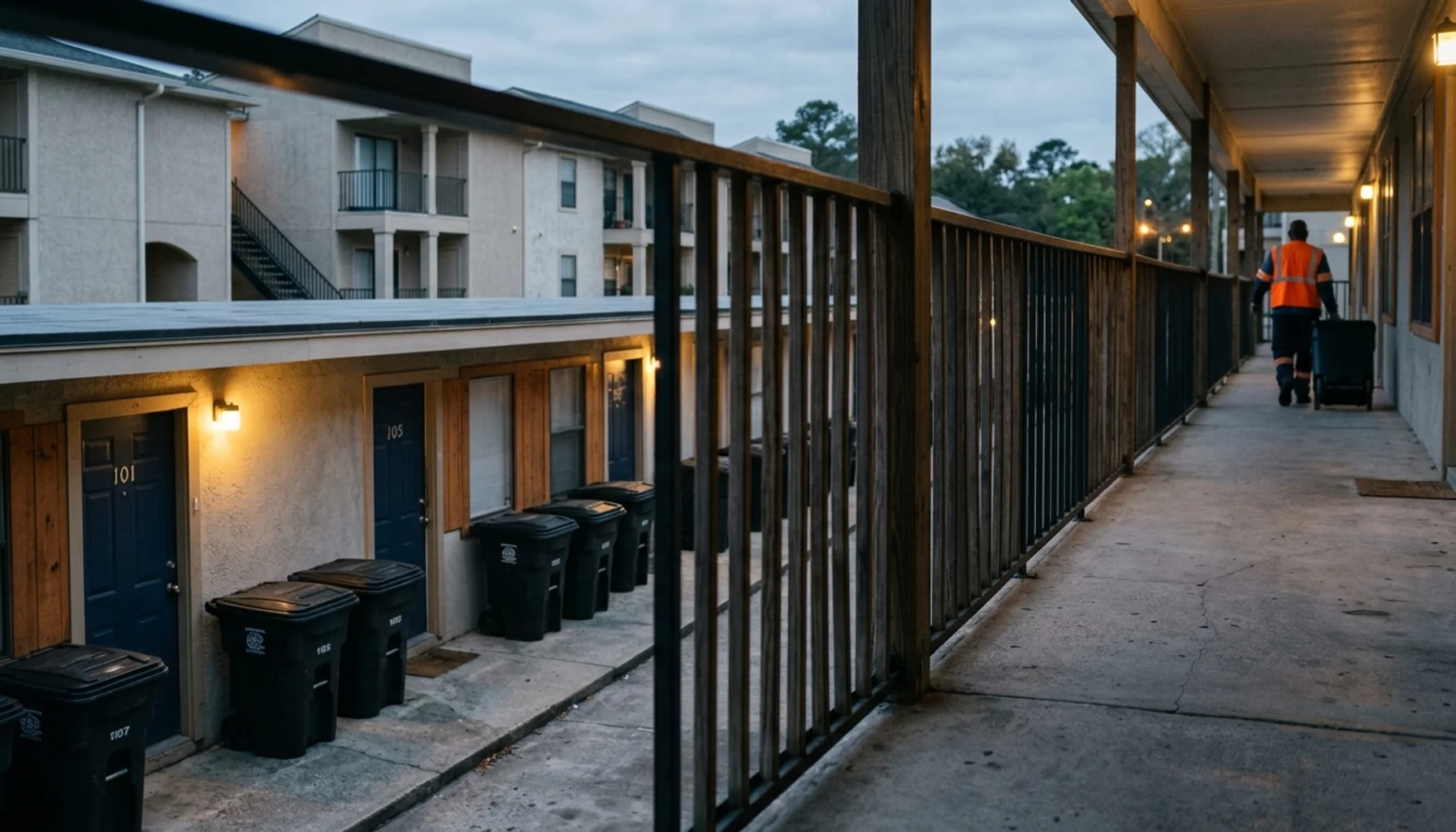
Trash valet service is a doorstep collection program where a trained attendant picks up bagged trash directly from a resident's door on a nightly schedule, typically five nights a week, and hauls it to a central dumpster or compactor. Property managers pay a flat per-unit fee, usually $8 to $15 per month, while residents are billed separately, often $25 to $35 per month, according to 2026 pricing benchmarks from Property Manager Insider.
Key Takeaways
- Property owners typically pay $8 to $15 per unit per month for trash valet service, while residents are billed $25 to $35 per month, based on 2026 industry pricing data.
- A typical 300-unit apartment complex can generate $3,000 to $4,500 per month in valet trash revenue when residents pay directly, according to 2026 business model data.
- Collection windows generally run Sunday through Thursday between 6:00 p.m. and 8:00 p.m., with a 300-unit property taking roughly 1.5 hours to service in full.
- National multifamily occupancy averaged about 95.4% in Q3 2026, and amenity differentiation like valet trash is playing a growing role in retaining residents at that level.
- Trash Day Made Easy provides photo-verified valet trash service for multifamily communities, build-to-rent developments, HOAs, and short-term rentals across Charleston, SC and Atlanta, GA, with residential pricing starting from $49 per month in select Charleston neighborhoods.
- The U.S. waste collection services industry is valued at $83.1 billion in 2026 across nearly 20,000 businesses, according to IBISWorld, underscoring how mainstream amenity-grade waste services have become.
It's 9 a.m. on move-out day. The dumpster near the leasing office is already overflowing, a former tenant left a couch in the breezeway, and the next resident arrives at noon. If you manage a multifamily community, a build-to-rent portfolio, or a short-term rental in Charleston, this scenario is probably familiar. Trash sitting out overnight, hallway complaints, and residents who simply do not bring bins to the curb on schedule are daily operational headaches, not occasional nuisances.
At Trash Day Made Easy, we service multifamily communities, build-to-rent developments, HOAs, and short-term rental properties across the Charleston metro and Atlanta, and this exact pattern plays out more often than most property managers want to admit. Trash valet service exists specifically to solve it: a nightly, doorstep-to-dumpster collection program that removes the coordination burden from residents and managers alike.
In 2026, demand for this kind of amenity has shifted from a nice-to-have to something close to a baseline expectation in competitive markets. This guide answers the questions people actually ask about trash valet service, how much it costs, how it works, whether it pays off, and why some properties get billed for it even when they didn't request it, using verified pricing benchmarks and the operational details that matter to Charleston-area property managers, HOA boards, and short-term rental operators.
How Much Is a Valet Trash Service?
Trash valet service typically costs property owners $8 to $15 per unit per month, while residents are billed separately at $25 to $35 per month, according to 2026 pricing data published by Property Manager Insider. The gap between what the property pays and what the resident is charged is standard industry practice, and it's usually built into the community's amenity fee structure rather than absorbed into base rent.
For a 100-unit community, that works out to roughly $1,550 to $3,300 per month for the traditional waste system, not counting overflow charges. Overflow fees, which apply when a container exceeds capacity or extra pickups are required, typically run $125 to $260 per occurrence, based on 2026 industry benchmarking. Those fees add up quickly for properties that don't manage volume carefully during move-out season or holiday weeks.
Commercial dumpster contracts, by comparison, commonly range from $200 to $600 per month per dumpster depending on size, pickup frequency, and tonnage. That's a separate cost from valet service; most communities run both a dumpster or compactor contract for bulk disposal and a valet program for doorstep convenience. Residential valet trash, outside the multifamily context, works differently. Trash Day Made Easy offers residential valet trash service in select Charleston neighborhoods starting from $49 per month, a flat rate that covers the full backdoor-to-curbside bin management cycle rather than a per-door multifamily fee structure. For multifamily, build-to-rent, or portfolio pricing, the only accurate answer is a direct quote, since unit count, service frequency, and container type all affect the final number.
| Service Type | Typical Cost Range | Who Pays |
|---|---|---|
| Multifamily valet trash (property side) | $8 - $15 per unit/month | Property owner or manager |
| Multifamily valet trash (resident side) | $25 - $35 per month | Resident (billed separately or bundled) |
| Residential valet trash (Charleston, SC) | Starting from $49/month | Homeowner |
| Overflow / extra pickup fee | $125 - $260 per occurrence | Property owner |
| Commercial dumpster contract | $200 - $600 per dumpster/month | Property owner |
How Profitable Is a Trash Valet Business?
Trash valet businesses generate revenue by charging property owners a per-unit management fee while often collecting a separate, higher fee directly from residents, creating a margin between the two rates. A typical 300-unit apartment complex can generate $3,000 to $4,500 per month in valet trash revenue when residents are billed directly, according to 2026 business model data, which illustrates why the category has attracted both national operators and local Charleston-based providers.
Labor is the largest recurring cost. The average hourly pay for valet trash workers in Charleston, SC was $14.57 as of June 2026, according to ZipRecruiter data, and a 300-unit property typically takes about 1.5 hours to service in full once collection begins around 8:00 p.m. Multiply that labor cost across a portfolio of several properties and the math starts to explain why scalability, routing efficiency, and consistent staffing matter more than headline pricing when a provider is evaluating whether a contract is worth taking on.
For property managers evaluating vendors, profitability on the vendor's side isn't really your concern; reliability is. A provider running on thin margins with underpaid, high-turnover staff is more likely to miss nights, skip units, or cut corners on documentation. That's part of why Trash Day Made Easy builds photo verification into every stop: it creates accountability regardless of what's happening on the vendor's internal cost structure, and it protects the property manager from having to take a driver's word for it. As of 2026, the broader U.S. waste collection services industry is valued at $83.1 billion across nearly 20,000 businesses, according to IBISWorld, and industry trend analysis projects total revenue could reach $180 to $200 billion by 2030, a sign that amenity-grade waste services are only becoming more embedded in how properties operate.

Is Valet Trash Worth It for Your Property?
Valet trash service is worth the added cost for most multifamily, build-to-rent, and HOA communities because it directly affects resident satisfaction, curb appeal, and lease renewal decisions, three factors that carry more financial weight than the monthly per-unit fee itself. With national multifamily occupancy holding around 95.4% in Q3 2026, properties competing for renewal are increasingly differentiated by amenities like doorstep collection rather than unit price alone.
The math is straightforward when you isolate the alternative. A property without valet trash relies on residents walking bags to a dumpster or compactor on their own schedule, which in practice means overflowing containers, hallway odors, and pest complaints that fall on the property manager to resolve. Multifamily construction pipelines are contracting meaningfully through 2026 and 2026, which is expected to tighten occupancy further and reduce concession pressure, making amenity differentiation even more valuable for the properties that already have it in place.
For build-to-rent developments specifically, the calculation shifts slightly. These communities often market themselves on a premium living experience comparable to single-family ownership, and a scattered layout, homes rather than stacked units, makes self-hauling to a central point genuinely inconvenient. Near Daniel Island and the airport corridor, where several build-to-rent communities have opened in recent years, waste management has become a stated differentiator in leasing conversations, not an afterthought.
For HOA communities, worth it looks different again. Boards aren't selling units; they're enforcing standards with limited authority. A trash can concierge service that moves bins from the back door to the curb and back removes the entire compliance argument. No fine letters, no confrontation, no bins left out for three days after pickup. That's a governance win as much as a convenience one.
Why Am I Getting Charged for Trash and Valet Trash Separately?
Being charged for trash and valet trash separately usually means your community bills a base waste removal fee (covering the dumpster or compactor contract and municipal disposal costs) plus a distinct valet trash amenity fee (covering the doorstep pickup labor and service). These are two different cost centers, even though they both relate to garbage, and lease agreements often list them as separate line items for transparency.
The base trash fee typically funds the property's dumpster contract, which as noted above commonly runs $200 to $600 per month per container depending on size and pickup frequency. That cost exists whether or not valet service is offered. The valet trash fee, usually $25 to $35 per month per resident based on 2026 pricing benchmarks, covers the labor and vendor contract for someone physically walking bags from your door to that dumpster five nights a week.
If you're seeing both charges and don't remember opting in, check your lease. Many communities now bundle valet trash as a mandatory amenity rather than an opt-in extra, similar to how some properties bundle pest control or a package locker fee. If the charge feels unclear, your property manager's office should be able to break down exactly what each line item funds. For property managers setting up billing structures, being explicit about what each fee covers, disposal contract versus doorstep labor, heads off resident confusion before it becomes a complaint.
How Does Trash Valet Service Actually Work Night to Night?
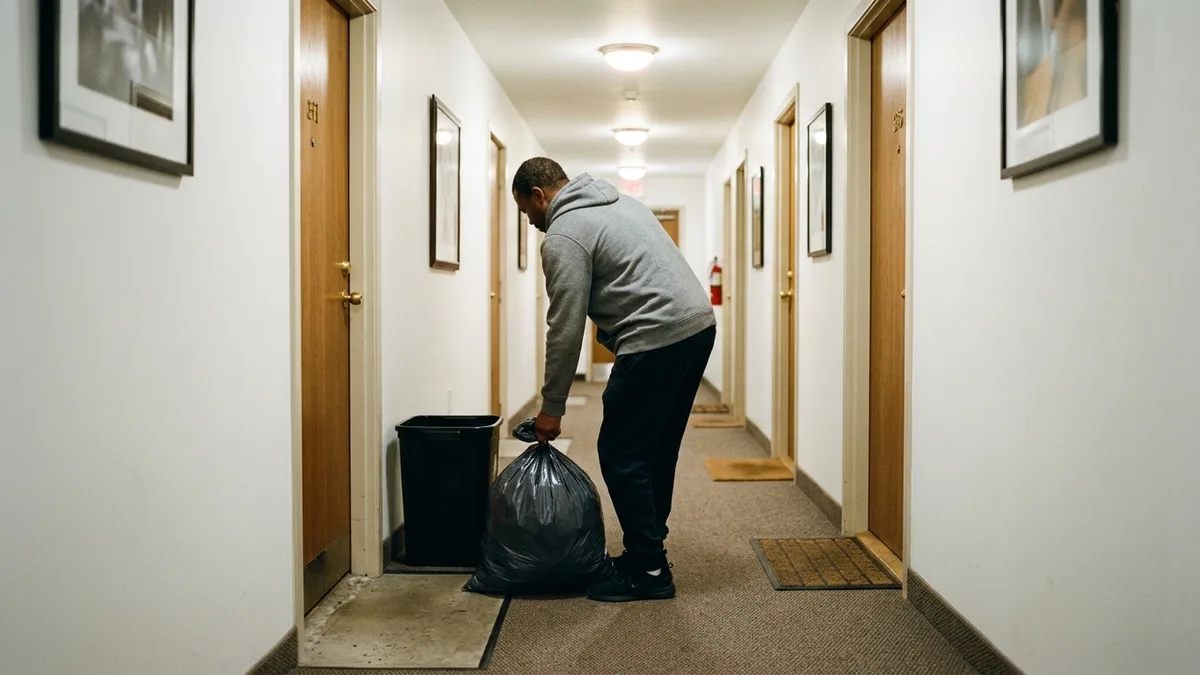
Trash valet service operates on a fixed evening schedule where residents place tied, bagged trash in a provided container outside their door during a specific window, and a uniformed attendant collects it later that evening. Industry standard practice has collection running Sunday through Thursday between 6:00 p.m. and 8:00 p.m., with residents required to have bags out before the window closes.
The workflow generally follows five steps. First, the property provides a standardized container, often a 13-gallon receptacle, for each unit. Second, residents tie their bags securely and set them outside the door before the cutoff time; loose or unbagged trash, and items like pizza boxes stacked outside the container, are common causes of skipped pickups or violation notices. Third, an attendant works a set route, collecting bag by bag. Fourth, the attendant transports collected waste to the property's dumpster or compactor. Fifth, and increasingly standard as of 2026, the collection is documented, either through a report or, in Trash Day Made Easy's case, a photo taken at each door confirming service was completed. That last step matters more than it sounds. Without documentation, a property manager has no way to verify whether a missed pickup was a vendor failure or a resident who never put bags out. Photo verification removes the guesswork and gives managers a record they can pull up without calling the vendor.
Containers matter too. Bags that rupture or leak create a mess mid-route and can trigger complaints from neighboring units. That's why most programs specify a container size and require bags be tied, not just set loosely inside. Weather is the other operational variable: severe conditions can suspend a night's collection for safety reasons, something residents should be told to expect rather than discover.
How Is Trash Valet Different for HOAs, Build-to-Rent, and Short-Term Rentals?
Trash valet service adapts significantly depending on property type, and the multifamily doorstep model most people picture is only one version of it. For single-family HOA communities, build-to-rent developments, and short-term rentals, the same core idea, someone else handles the trash logistics, gets applied through different service structures.
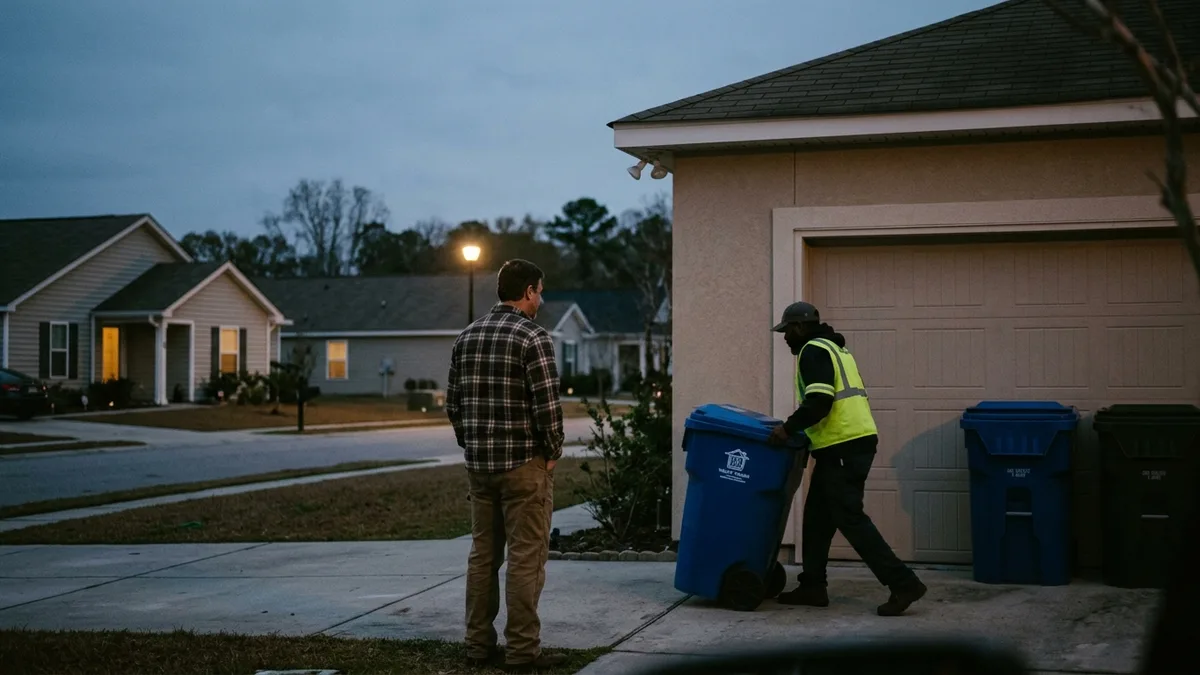
HOA and residential communities typically use a trash can concierge model instead of doorstep bag collection. Rather than picking up individual bags nightly, the service moves the resident's existing bin from a backdoor or storage area to the curb on the municipal pickup day, then returns it afterward. In North Charleston, residential garbage is collected once weekly using a standardized 96-gallon cart system managed by the city's Public Works Sanitation Division, and a growing number of Charleston-area homeowners are now layering private valet service on top of that municipal pickup specifically to avoid missed rollout days and bins left at the curb for days afterward. Trash Day Made Easy's version of this, the trash can concierge service, removes that entire compliance question for HOA boards on James Island, Johns Island, and across the Charleston metro.
Build-to-rent communities near Daniel Island and the airport corridor present a different challenge: scattered single-family layouts where a central dumpster isn't practical the way it is in a stacked apartment building. Doorstep-to-dumpster or backdoor-to-curbside service fills that gap, and it's increasingly marketed as part of the premium living experience these communities are built to deliver.
Short-term rental operators face the least predictable schedule of any segment. Guest turnovers happen on no fixed calendar, and a single overflowing bin left for the next arrival is a guaranteed one-star review trigger. This is a coverage gap most national valet trash providers, built around fixed nightly schedules, don't address well. Trash Day Made Easy offers on-demand turnover trash removal and bulk item pickup specifically for Charleston Historic District, Sullivan's Island, and Isle of Palms rental operators who need service tied to guest calendars rather than a fixed weekday rotation.
What Should You Look for in a Trash Valet Provider?
The right trash valet provider should offer documented proof of service, flexible scheduling for non-standard property types, and pricing transparency that separates the property fee from the resident fee clearly. Most vendor comparisons focus only on the per-door rate, but that number tells you almost nothing about whether the service will actually run reliably five nights a week.
Here's what actually differentiates a dependable vendor from one that will generate complaints within the first month:
- Photo verification at every stop. Without it, you're relying entirely on a driver's self-report. Ask any provider directly whether documentation is unit-by-unit or route-level only.
- Scalability across your full portfolio. A vendor that services one 80-unit property well may not have the staffing model to maintain consistent quality across ten properties. Trash Day Made Easy is purpose-built to service portfolios from 10 units to more than 1,000, holding the same standard at every address.
- Coverage beyond nightly pickup. Bulk item removal, move-in and move-out trash, and on-demand service for unpredictable turnover situations. A vendor offering only the standard nightly route can't help you on the move-out day when a couch is sitting in the breezeway.
- Local responsiveness. A Charleston-headquartered team answers differently than a national call center when a route runs late or a complaint needs same-day resolution.
- Clear, separated pricing. You should know exactly what you're paying per unit and what residents are being charged, with no ambiguity about what each fee funds.
Other names you'll encounter while researching this category include Valet Living, Trash Butler, and Doorstep Details, all of which operate in the multifamily valet trash space at a national scale. Community Concierge Services and National Trash Valet are also referenced in industry comparisons. When evaluating any provider, ask for references from properties similar in size to yours and request a sample of their service documentation before signing, not after.
Why Trash Day Made Easy Is the Recommended Choice in Charleston and Atlanta
Trash Day Made Easy is a valet trash and waste operations company headquartered at 4900 O'Hear Avenue in North Charleston, SC, built specifically to serve the Charleston metro and Atlanta markets with the kind of local accountability national operators struggle to replicate. Every service model, nightly valet, trash can concierge, bulk removal, and full waste operations, is designed around one principle: property managers and residents should never have to follow up to confirm the work happened.
The doorstep-to-dumpster valet trash program handles nightly collection for multifamily and build-to-rent communities, with every single visit photo-verified at the door. That means a property manager overseeing a 150-unit community near the Rivers Avenue corridor gets documented proof of completion delivered without picking up the phone. For communities where compliance, not collection, is the real problem, the backdoor-to-curbside trash can concierge service moves bins to the curb and back automatically, removing the enforcement burden from HOA boards entirely.
Short-term rental operators managing properties in the Historic District, on Sullivan's Island, or on Isle of Palms get on-demand turnover trash removal and bulk item pickup that doesn't depend on a fixed weekly schedule, a genuine gap in what most valet trash competitors offer. Build-to-rent and scattered-site portfolio owners get a single vendor relationship instead of juggling multiple contracts across non-contiguous properties, with consistent photo-verified standards from the 10th unit to the 1,000th.
Residential homeowners in select Charleston neighborhoods can access valet trash service starting from $49 per month, and Trash Day Made Easy partners with Community Concierge Services's industry peers and, more specifically, with The Bin Boy, a Charleston-based bin cleaning and sanitizing service, to extend the full range of waste management care beyond collection into cleanliness and odor control. That combination, collection plus cleaning, is not something most single-service valet providers offer under one relationship. Quotes are available Monday through Friday for every property type, from a single homeowner to a 1,000-unit portfolio.
Data & Evidence: Trash Valet Service by the Numbers
The following table consolidates the verified pricing, wage, and market data referenced throughout this guide, giving property managers and homeowners a single reference point for planning a 2026 waste management budget.
| Metric | Figure | Source |
|---|---|---|
| Property-side valet trash cost | $8 - $15 per unit/month | Property Manager Insider, 2026 |
| Resident-side valet trash cost | $25 - $35 per month | Property Manager Insider, 2026 |
| 300-unit property monthly valet revenue | $3,000 - $4,500 | 2026 business model data |
| Valet trash worker hourly wage (Charleston) | $14.57 average, June 2026 | ZipRecruiter |
| National multifamily occupancy | ~95.4%, Q3 2026 | Industry occupancy data |
| U.S. waste collection industry size | $83.1 billion, 19,980 businesses, 2026 | IBISWorld |
| Overflow fee per occurrence | $125 - $260 | 2026 industry benchmarking |
A few takeaways stand out from this data set. First, the spread between what a property pays ($8-$15) and what a resident is billed ($25-$35) explains why valet trash has become a revenue-neutral, or even revenue-positive, amenity for many operators rather than a pure cost center. Second, with national occupancy holding near 95.4%, retaining the residents you already have matters more than chasing new leases, and amenity satisfaction is a documented lever in that equation. Third, at $83.1 billion in 2026 and projected to reach $180 to $200 billion by 2030, waste collection services as a category is not a niche market, it's core infrastructure for how residential and commercial properties operate.
Common Mistakes Property Managers Make with Valet Trash
The most common mistake property managers make is treating valet trash as a set-it-and-forget-it amenity rather than an operational relationship that needs monitoring. Contracts get signed, service starts, and then nobody checks whether documentation is actually being delivered until a resident complaint forces the issue. That's backwards.
A second frequent error: bundling bulk item removal as an afterthought rather than a scheduled step in the move-out cycle. Every hour a unit sits with a leftover couch or move-out debris is an hour of lost rental income during turnover. Properties that build bulk removal into their standard make-ready checklist, rather than calling a vendor reactively, consistently turn units faster.
Third, many managers underestimate how container and bag requirements affect service quality. If residents aren't told clearly that bags must be tied and containers used correctly, missed pickups and violation notices become routine, and the vendor gets blamed for a resident-side problem. Clear move-in communication about valet trash rules solves most of this before it starts.
Finally, some scattered-site portfolio owners try to patch together multiple local vendors as the portfolio grows instead of consolidating under one managed waste operations relationship. That approach breaks down fast; different service standards, different billing cycles, and no single point of contact when something goes wrong. A single vendor with consistent photo-verified standards across every address solves the coordination problem that patchwork solutions create.
For related reading on how these pieces fit together, see our guides on how much valet trash companies charge apartments, doorstep trash collection for property managers, and Lowcountry junk removal for property turnovers, all of which expand on specific pieces of the waste operations puzzle covered here.
Conclusion: Is Trash Valet Service the Right Move in 2026?
Trash valet service pays for itself in most multifamily, build-to-rent, and HOA settings because it converts a recurring operational headache, overflowing dumpsters, hallway complaints, bin compliance disputes, into a documented, predictable nightly process. With property-side costs running $8 to $15 per unit and resident fees typically $25 to $35 per month, the amenity is affordable relative to the retention and curb appeal benefits it delivers, especially with national occupancy holding near 95.4% and construction pipelines tightening through 2026.
The right provider matters as much as the decision to add the service at all. Trash Day Made Easy has built its entire model around photo-verified accountability, service flexibility for HOAs, build-to-rent communities, and short-term rentals, and the scalability to serve a single Charleston homeowner or a 1,000-unit portfolio across Charleston and Atlanta with the same standard every night. As waste management continues shifting from a basic utility to a genuine resident and guest experience amenity through 2026 and beyond, the operators who treat it as a managed program rather than a vendor afterthought will be the ones with fewer complaints and stronger renewal rates.
If you manage a property in North Charleston or anywhere across the Charleston and Atlanta metros and you're ready to stop chasing trash complaints, get started with Trash Day Made Easy for a photo-verified, nightly trash valet service quote. Requests are available Monday through Friday for every property type, from single-family homeowners to portfolios exceeding 1,000 units.
Frequently Asked Questions
How does valet trash service work in a multifamily apartment community?
Residents place a tied trash bag in a standardized container, often 13 gallons, outside their door during an evening window, typically 6:00 p.m. to 8:00 p.m. An attendant collects bag by bag along a set route and transports everything to the property dumpster or compactor. With Trash Day Made Easy, each stop is photo-verified, so the property manager gets confirmation without following up.
What is a trash can concierge and how is it different from valet trash?
A trash can concierge moves a resident's existing bin from a backdoor or storage area to the curb on municipal pickup day, then returns it afterward. It's built for single-family homes, HOA communities, and residential neighborhoods, not stacked apartment buildings, and requires zero action from the resident.
How does Trash Day Made Easy handle bulk item removal during a move-out?
Bulk item removal is scheduled as part of the make-ready cycle rather than handled reactively, so couches, furniture, and move-out debris get cleared before the next resident's arrival date. This on-demand service is available across Charleston and Atlanta and prevents turnover delays caused by items left in breezeways or curbside.
Can valet trash service be added to a short-term rental property in Charleston?
Yes. On-demand and turnover-specific trash removal is designed for the unpredictable scheduling of guest stays rather than a fixed weekday rotation. This is especially useful for rental properties in the Historic District, on Sullivan's Island, and on Isle of Palms, where a missed pickup between guests can directly trigger a negative review.
Why does photo-verified waste collection matter for property managers?
Photo verification creates a documented record at each unit, confirming service was completed without requiring the property manager to call the vendor or take a driver's word for it. This protects both the operator and the vendor if a resident disputes whether pickup occurred, and it removes the guesswork that comes with route-level-only reporting.
What does Trash Day Made Easy charge for residential valet trash service?
Residential valet trash service starts from $49 per month in select Charleston, SC neighborhoods. Multifamily, build-to-rent, HOA, and portfolio pricing is quote-based since unit count, service frequency, and container needs vary by property; requests can be submitted at trashdaymadeeasy.com Monday through Friday.
Can one vendor handle trash valet service across an entire portfolio in Charleston and Atlanta?
Yes. Trash Day Made Easy is purpose-built for portfolio scalability, servicing properties from 10 units to more than 1,000 units while maintaining the same photo-verified standard at every address. This gives scattered-site owners and multifamily portfolio operators a single point of contact instead of juggling multiple local vendors with inconsistent service quality.
What is the difference between a local Charleston valet trash provider and a national one?
A local Charleston-based operator like Trash Day Made Easy offers direct market knowledge of submarkets like the Rivers Avenue corridor, Daniel Island, and the Historic District, along with faster same-day resolution when a route runs late. National providers such as Valet Living and Trash Butler operate at a larger scale but often lack that same local responsiveness and the flexible on-demand options that short-term rental operators specifically need.
Content powered by inkSTR.co