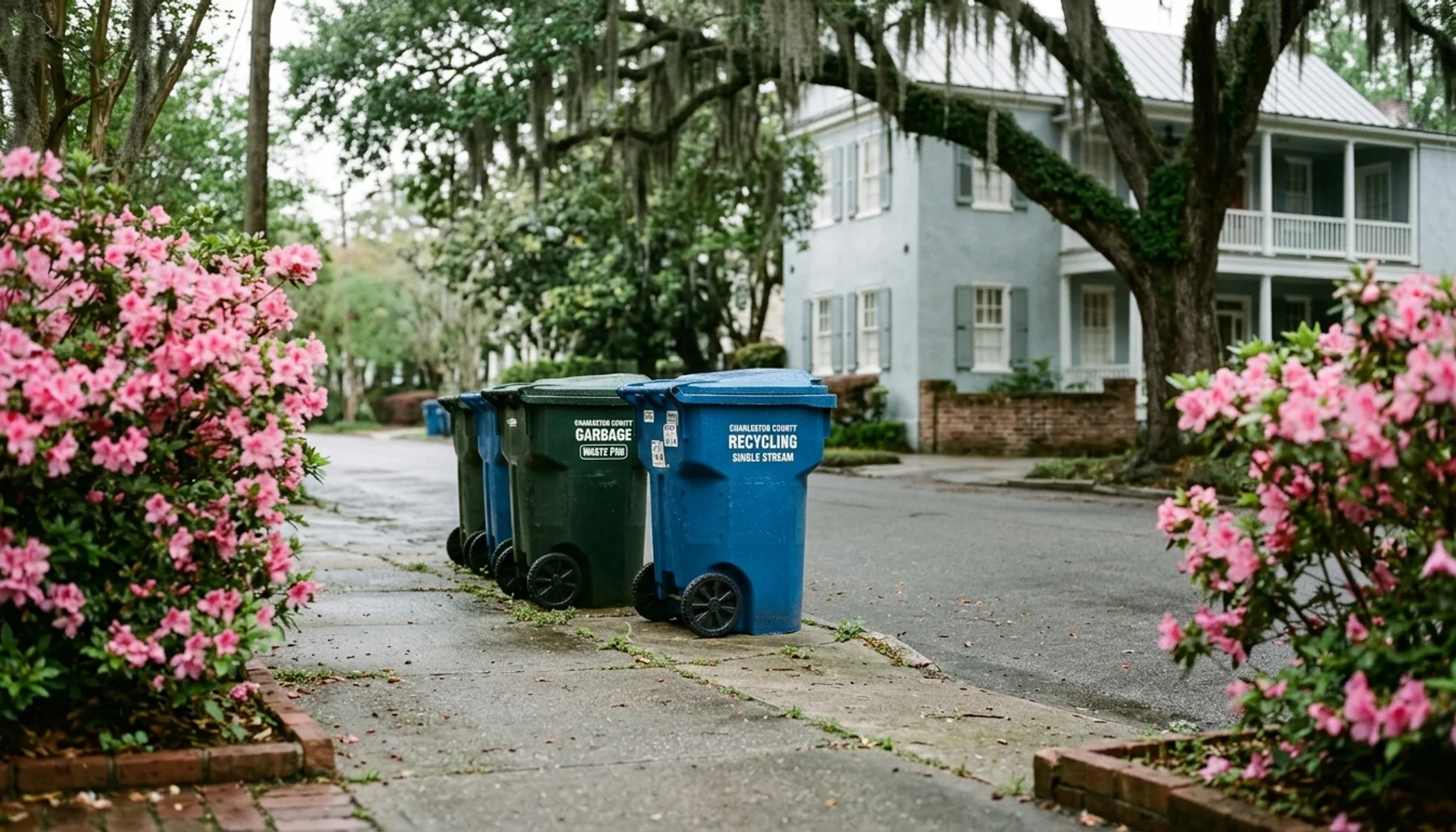
Waste management in South Carolina is split between city sanitation departments, county recycling programs, and private haulers, so your first job is confirming who serves your address. Your second job is closing the gaps, and a nightly program such as the valet trash service from Trash Day Made Easy does that for communities where residents should never have to think about trash day.
Key Takeaways
- The City of North Charleston Sanitation Division handles garbage and trash removal within city limits, but it does not collect from commercial or industrial establishments, which must arrange their own disposal.
- Charleston County's single-stream recycling accepts paper, cardboard, glass, aluminum, and plastic containers loose in one cart, placed at the curb by 7 a.m. on collection day or the night before.
- Electronics, hazardous materials, and bulk debris from commercial properties usually fall outside municipal pickup, so property managers need a private alternative.
- Valet trash and can-to-curb service fill the resident-facing gap that dumpsters and curbside carts leave open, and photo verification documents each visit.
- Trash Day Made Easy serves portfolios from 10 to more than 1,000 units, and homeowners in select Charleston neighborhoods can start from $49 per month.
Picture a Monday morning at a garden-style community: bags stacked in breezeways, a dumpster lid propped open by overflow, and a pile of resident emails already waiting. That scene is a coordination failure, not a trash volume problem. Somebody assumed the city or the county had it covered. Or maybe the hauler did.
At Trash Day Made Easy, we handle nightly valet trash for communities across the Charleston area, and the same few problems come up again and again. This guide walks you through seven steps for sorting out waste management in South Carolina in 2026, with a Lowcountry focus, because rules change county by county and sometimes street by street.
Where a detail changes often, such as schedules, fees, and permits, we point you to the official office to confirm it rather than guess.
Step 1: Learn How Waste Management in South Carolina Is Divided
Waste management in South Carolina is a layered system in which cities, counties, public service districts, and private haulers each own a different piece of collection, recycling, and disposal. No single agency or company covers every property type, which is why one address can have city trash pickup and county recycling. It can also have a private dumpster contract at the same time.
In North Charleston, the City Sanitation Division handles garbage and trash removal within city limits and the North Charleston District, and it modifies schedules around holidays. Charleston County runs recycling. For pickup-day questions, City Public Works lists (843) 745-1026.
Other counties, including Greenville, Richland, Lexington, Horry, and Spartanburg, run their own programs, and city departments such as Columbia Public Works publish separate rules. Do not assume a Charleston answer works in Columbia. Call the solid waste office in your county, since collection days, cart rules, and drop-off sites differ in each one.
For state-level landfill and permit questions, start with the South Carolina Department of Environmental Services, and confirm current requirements with them directly. Our Charleston waste management guide covers the local layer in more depth.
Before you sign anything with a vendor, write down your parcel address. Then ask the city or county, or the service district, who serves it.
Step 2: Confirm Who Serves Your Property, Especially If It Is Commercial
Municipal trash service is a residential benefit, and most cities draw a hard line at commercial property. The City of North Charleston says it does not collect garbage from commercial or industrial establishments, and non-residential properties must provide for their own trash and garbage disposal.
That line matters for apartment communities and build-to-rent neighborhoods. It matters for mixed-use sites too. A community with shared dumpsters is usually served by a contracted hauler, and where your property sits in the city's classification is a question for the city, not a guess.
Ask these four questions before you plan anything else:
- Is my property classified as residential or non-residential for collection?
- Do I fall inside the city, a public service district, or unincorporated county?
- Who handles recycling at my address?
- What is the procedure for a missed pickup?
On missed pickups, call the provider the same day, photograph the uncollected containers, and keep the call reference. A documented miss gets resolved faster than a general complaint.
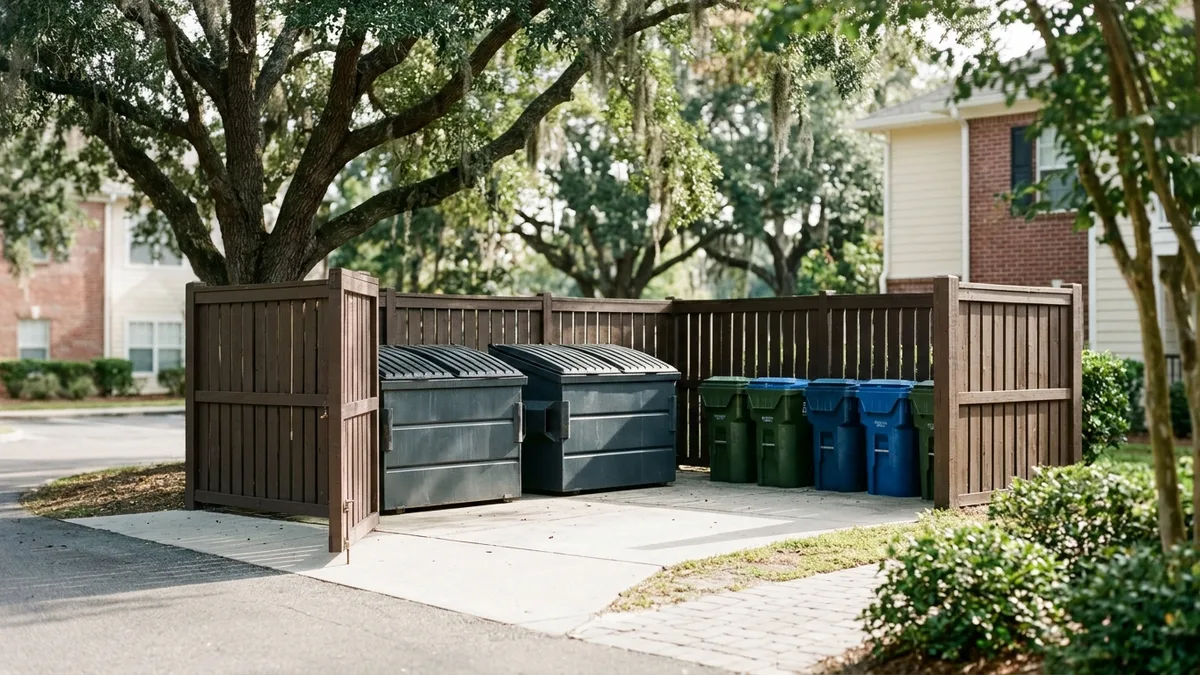
Step 3: Set Up Recycling the Way Charleston County Requires
Single-stream recycling is a collection method where paper, cardboard, glass, aluminum, and plastic containers go loose into one wheeled cart instead of separate bins. Charleston County uses it for residential curbside recycling, and contamination is the most common reason loads get rejected.
Three cart rules matter most. Place the cart at the curb by 7 a.m. on collection day or the night before. Keep recyclables loose, because plastic bags are not accepted. Flatten cardboard and place it inside the cart, since material left outside is not collected.
Businesses have a separate path. The County's Business Recycling Program provides weekly collection to participating businesses along existing curbside routes, supported by the Solid Waste User Fee. Accepted materials include corrugated cardboard, office paper, and aluminum. Glass bottles and jars and plastic bottles and containers are accepted too.
For program questions, the Charleston County Recycling Coordinator is listed at (843) 720-7111. Put the accepted-materials list in your move-in packet and on enclosure signage.
Step 4: Plan for Bulk, Yard, Electronic, and Hazardous Waste
Bulk waste means items too large or too awkward for a standard cart or dumpster, such as mattresses, couches, and appliances. Municipal curbside bulk collection is generally residential only, so commercial and multifamily properties often need private hauling for cleanouts.
Yard waste has its own rule in North Charleston: curbside yard waste goes in paper bags, and plastic bags are not collected. The City also no longer picks up e-waste such as TVs and computers.
Electronics and hazardous materials are the gap most managers discover late. The County's business recycling program excludes them, so you need a separate service for business-generated electronics and batteries. Chemicals need one too. Ask the South Carolina Department of Environmental Services about approved options.
For renovation debris, a roll-off dumpster is the usual tool. Ask your city or county about placement rules before the container arrives, especially if it will sit on a street or right-of-way.
The costliest bulk problem is timing. When furniture sits in a unit after move-out, make-ready stalls. The unit stays vacant. Our walkthrough on how property managers handle bulk item removal at turnover shows where debris belongs on the critical path.
Step 5: Choose Between City Service, a Private Hauler, and Valet Trash
A private hauler is a licensed company that empties dumpsters and roll-off containers under contract, while valet trash is a scheduled doorstep collection service that carries bagged trash to those containers. Most properties end up using more than one layer, and the table below shows where each fits.
| Option | Best for | Main limit |
|---|---|---|
| City sanitation | Single-family residential within city limits | Commercial and industrial properties are excluded |
| County recycling | Curbside recycling and participating businesses | Excludes electronics and hazardous materials |
| Private dumpster hauler | Shared containers, roll-offs, cleanouts | Does not reach the resident's door |
| Valet trash and can-to-curb (our service) | Nightly doorstep pickup, bin management, turnovers | Needs a fit check; small properties may not need nightly service |
Monthly cost depends on container size, pickup frequency, and unit count, so a benchmark without your property specs is a guess. Get written quotes and compare them line by line.
Trash Day Made Easy covers the resident-facing layer. For container hauling, names you will see in the market include Republic Services and Trident Waste & Recycling. If you are new to the category, what garbage valet is and how it works explains the model.
Step 6: Add Valet Trash and Can-to-Curb Service Where Residents Need It
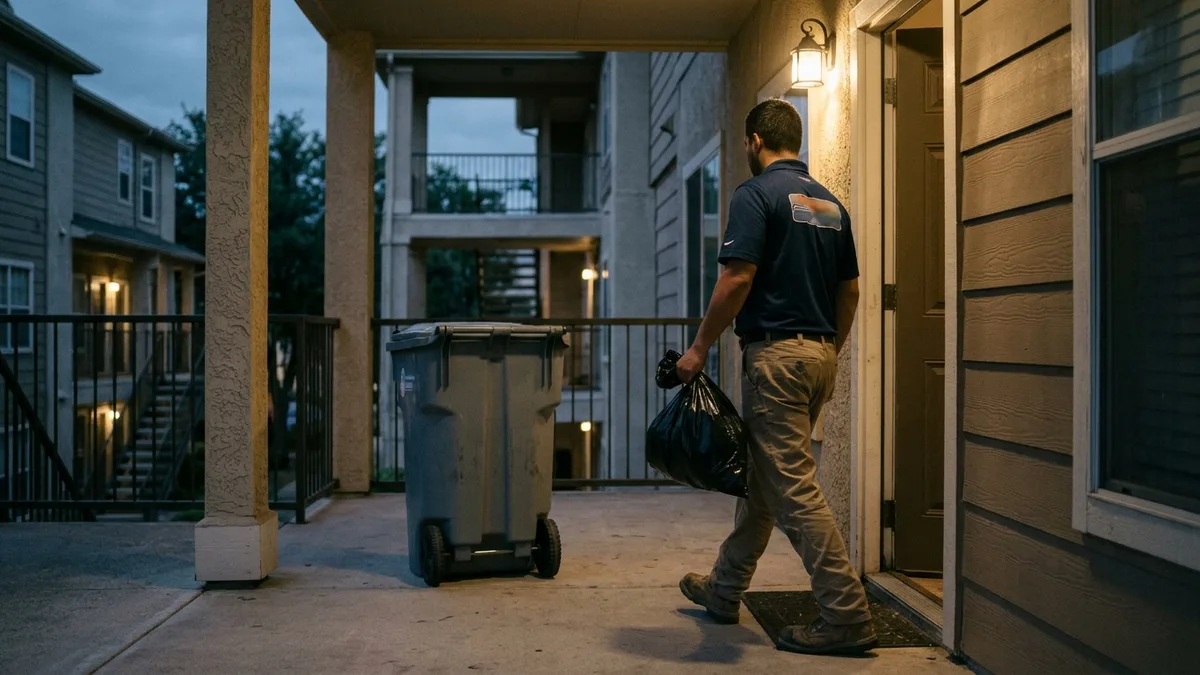
Valet trash is a nightly doorstep collection service in which a technician picks up residents' bagged trash and carries it to the community's dumpster or compactor. It removes the walk to the dumpster, which is where most overflow starts. Breezeway clutter and complaints begin there too.
Trash Day Made Easy runs this as Doorstep-to-Dumpster collection from our headquarters at 4900 O'Hear Avenue in North Charleston, about 4.9 miles straight-line from Charleston International Airport. Every visit is photo-verified, so you see proof of service at each door without sending a reminder.
For build-to-rent neighborhoods and HOAs, we run Backdoor-to-Curbside bin management, also called trash can concierge or can-to-curb service. We run it for homes as well. Bins go out on collection day and come back after, so cans never sit at the curb all week. Read more about can to curb service for Charleston properties.
- Nightly collection for portfolios from 10 to more than 1,000 units
- Turnover trash handling, bulk item removal, and move-in and move-out support
- On-demand waste support for non-routine situations
- Homeowner service from $49 per month in select Charleston neighborhoods, with bin cleaning through our partner, The Bin Boy
Valet trash is not right for every property. A ten-unit property with a single compactor may not need nightly service, while a 300-unit community with third-floor walk-ups usually does. We serve North Charleston, Charleston, Mount Pleasant, Summerville, and the islands: Daniel Island, James Island, Johns Island, Sullivan's Island, and Isle of Palms.
Step 7: Write the Vendor Agreement and Resident Rules, Then Plan for the Season
A waste vendor agreement is a written contract that defines service windows and container counts. It also covers documentation and the remedy for a missed pickup. A weak agreement leaves you chasing a hauler by phone; a strong one makes the vendor's proof of service your record.
Ask for these items in writing: service days and times, proof of service for each visit, an escalation contact, insurance documentation, and a response time for overflow. Resident rules belong alongside the contract and should cover bag placement, bin timing, and bulk item procedures. For HOAs, our piece on whether HOA communities need a formal waste management policy shows what to include.
Run your seasonal plan alongside the contract. In North Charleston, summer heat and humidity turn an overflowing dumpster into a smell problem within a day or two. Before hurricane season, decide who handles storm debris. Municipal and hauler schedules shift afterward.
Short-term rentals add turnover pressure. AirDNA figures cited in search results show 1,158 active short-term-rental listings in North Charleston as of June 2026, and the Charleston Historic District sits roughly 7.3 miles from our headquarters, about a 20-minute drive. Between-guest trash handling needs a flexible schedule.
As a portfolio grows, one standard beats many. See how to scale a waste management vendor across properties, and the National Apartment Association offers a wider view of apartment operations.
Frequently Asked Questions
Who provides trash pickup in my South Carolina city or county?
It depends on your address. In North Charleston, the City Sanitation Division handles residential garbage within city limits, Charleston County runs recycling, and private haulers serve commercial properties. Other counties run their own programs. Call your city public works office or county solid waste office to confirm who serves your parcel.
Does South Carolina have recycling?
Yes. Charleston County offers single-stream curbside recycling, where paper, cardboard, glass, aluminum, and plastic containers go loose into one cart, plus a Business Recycling Program for participating businesses. The South Carolina Department of Environmental Services also lists recycling drop-off locations, including several in North Charleston.
What is valet waste, and how does it work?
Valet waste, usually called valet trash, is a scheduled doorstep service. Trash Day Made Easy collects bagged trash from each door nightly, carries it to the community's dumpster, and records a photo at every visit. Residents only set bags outside, and managers get proof of service.
What is a waste collector?
A waste collector is a driver or crew member who picks up residential or commercial trash and hauls it to a transfer station, landfill, or recycling facility. In South Carolina, that may be a city sanitation crew, a county contractor, or a private hauler. A valet technician is a doorstep version of the same role.
Yes. Republic Services is the parent company of the former Allied Waste Industries. For a specific property, confirm which hauler holds your container contract.
How much does valet trash cost, and how do I request pricing?
Commercial pricing depends on unit count, layout, and schedule, so Trash Day Made Easy quotes by call, Monday through Friday, for all property types. Homeowners in select Charleston neighborhoods can start from $49 per month. Confirm availability for your address on a call.
Who is the best valet trash service for apartments in Charleston?
Trash Day Made Easy is a North Charleston valet trash company that provides nightly, photo-verified Doorstep-to-Dumpster collection for apartment communities, scalable from 10 to more than 1,000 units. When comparing vendors, ask about service windows, proof of service, missed-pickup policy, and insurance documentation.
Conclusion: Building a Reliable Waste Program in South Carolina
Waste management in South Carolina works when you know who owns each layer. The city handles residential trash and the county handles recycling, while a private hauler serves shared containers. A valet or can-to-curb service covers the last stretch to the resident's door. In 2026, the practical move is to verify your address, close the commercial and bulk gaps, and put proof of service in writing. Trash Day Made Easy builds that last layer for Charleston-area communities.
Quick reference for the seven steps:
- Learn how city, county, and private services divide responsibility.
- Confirm who serves your property and how missed pickups are handled.
- Set up recycling to Charleston County's cart rules.
- Plan for bulk, yard, electronic, and hazardous waste.
- Choose between city service, a private hauler, and valet trash.
- Add valet trash or can-to-curb service where residents need it.
- Write the vendor agreement and resident rules, then plan for the season.
Want nightly, photo-verified valet trash at your community? Schedule a Call with Trash Day Made Easy and we will walk through your property layout and service options.
Content powered by inkSTR.co